The Scientific Method: Defending the integrity of physics

Is Science Undermining Itself?

by George Ellis & Joe Silk
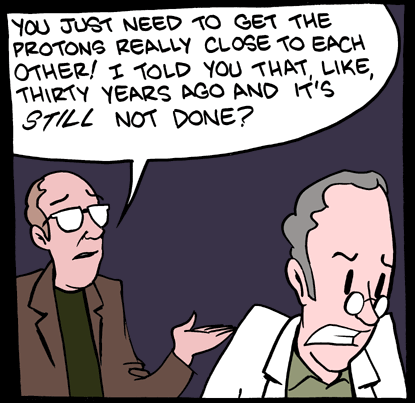
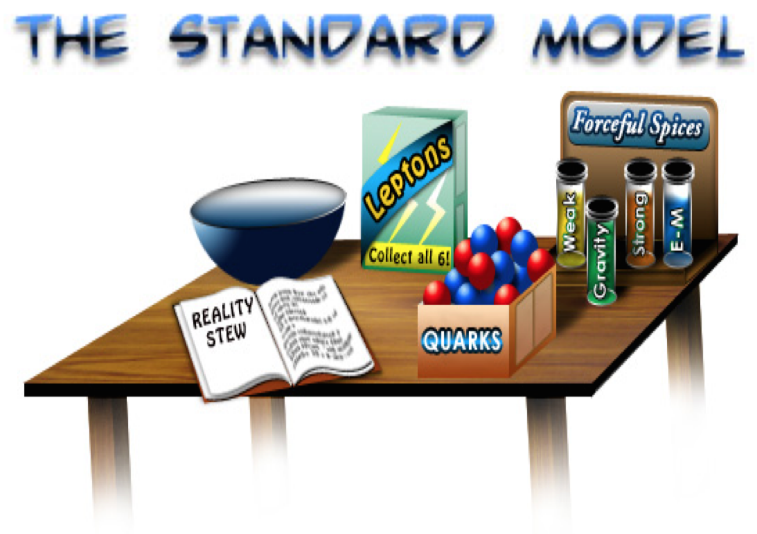
Credit: Saturday Morning Breakfast Cereal
(Credit: Saturday Morning Breakfast Cereal)

This year, debates in physics circles took a worrying turn. Faced with difficulties in applying fundamental theories to the observed Universe, some researchers called for a change in how theor­etical physics is done. They began to argue — explicitly — that if a theory is sufficiently elegant and explanatory, it need not be tested experimentally, breaking with centuries of philosophical tradition of defining scientific knowledge as empirical. We disagree. As the philosopher of science Karl Popper argued: a theory must be falsifiable to be scientific.

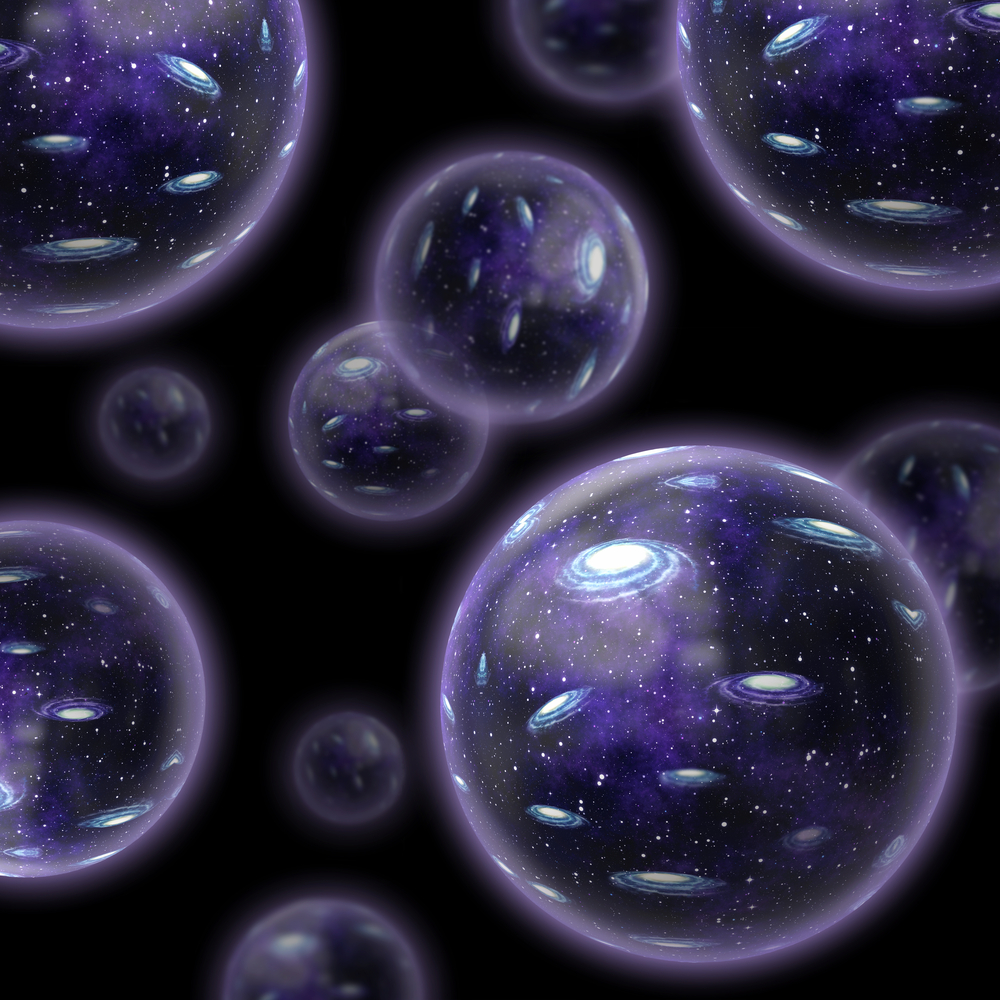
Chief among the ‘elegance will suffice’ advocates are some string theorists. Because string theory is supposedly the ‘only game in town’ capable of unifying the four funda­mental forces, they believe that it must con­tain a grain of truth even though it relies on extra dimensions that we can never observe. Some cosmologists, too, are seek­ing to abandon experimental verification of grand hypotheses that invoke imperceptible domains such as the kaleidoscopic multi­verse (comprising myriad universes), the ‘many worlds’ version of quantum reality (in which observations spawn parallel branches of reality) and pre-Big Bang concepts.

These unprovable hypotheses are quite different from those that relate directly to the real world and that are testable through observations — such as the standard model of particle physics and the existence of dark matter and dark energy. As we see it, theor­etical physics risks becoming a no-­man’s­ land between mathematics, physics and philosophy that does not truly meet the requirements of any.

The issue of testability has been lurking for a decade. String theory and multiverse theory have been criticized in popular books and articles, including some by one of us (G.E.). In March, theorist Paul Steinhardt wrote in this journal that the the­ory of inflationary cosmology is no longer scientific because it is so flexible that it can accommodate any observational result. Theorist and philosopher Richard Dawid and cosmologist Sean Carroll have coun­tered those criticisms with a philosophical case to weaken the testability requirement for fundamental physics.

We applaud the fact that Dawid, Carroll and other physicists have brought the problem out into the open. But the drastic step that they are advocating needs careful debate. This battle for the heart and soul of physics is opening up at a time when scien­tific results — in topics from climate change to the theory of evolution — are being ques­tioned by some politicians and religious fundamentalists. Potential damage to public confidence in science and to the nature of fundamental physics needs to be contained by deeper dialogue between scientists and philosophers.

STRING THEORY
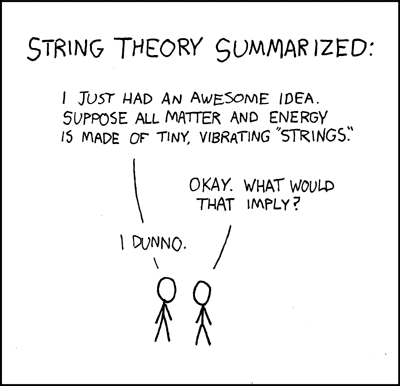
Is String Theory in trouble?(Credit: xkcd.com)
Is String Theory in trouble? (Credit: xkcd.com)

String theory is an elaborate proposal for how minuscule strings (one­-dimen­sional space entities) and membranes (higher­-dimensional extensions) existing in higher­-dimensional spaces underlie all of physics. The higher dimensions are wound so tightly that they are too small to observe at energies accessible through collisions in any practicable future particle detector.

Some aspects of string theory can be tested experimentally in principle. For example, a hypothesized symmetry between fermions and bosons central to string theory — super­ symmetry — predicts that each kind of particle has an as-­yet­-unseen partner. No such partners have yet been detected by the Large Hadron Collider at CERN, Europe’s particle­ physics laboratory near Geneva, Switzer­land, limiting the range of energies at which super-symmetry might exist. If these partners continue to elude detection, then we may never know whether they exist. Proponents could always claim that the particles’ masses are higher than the energies probed.
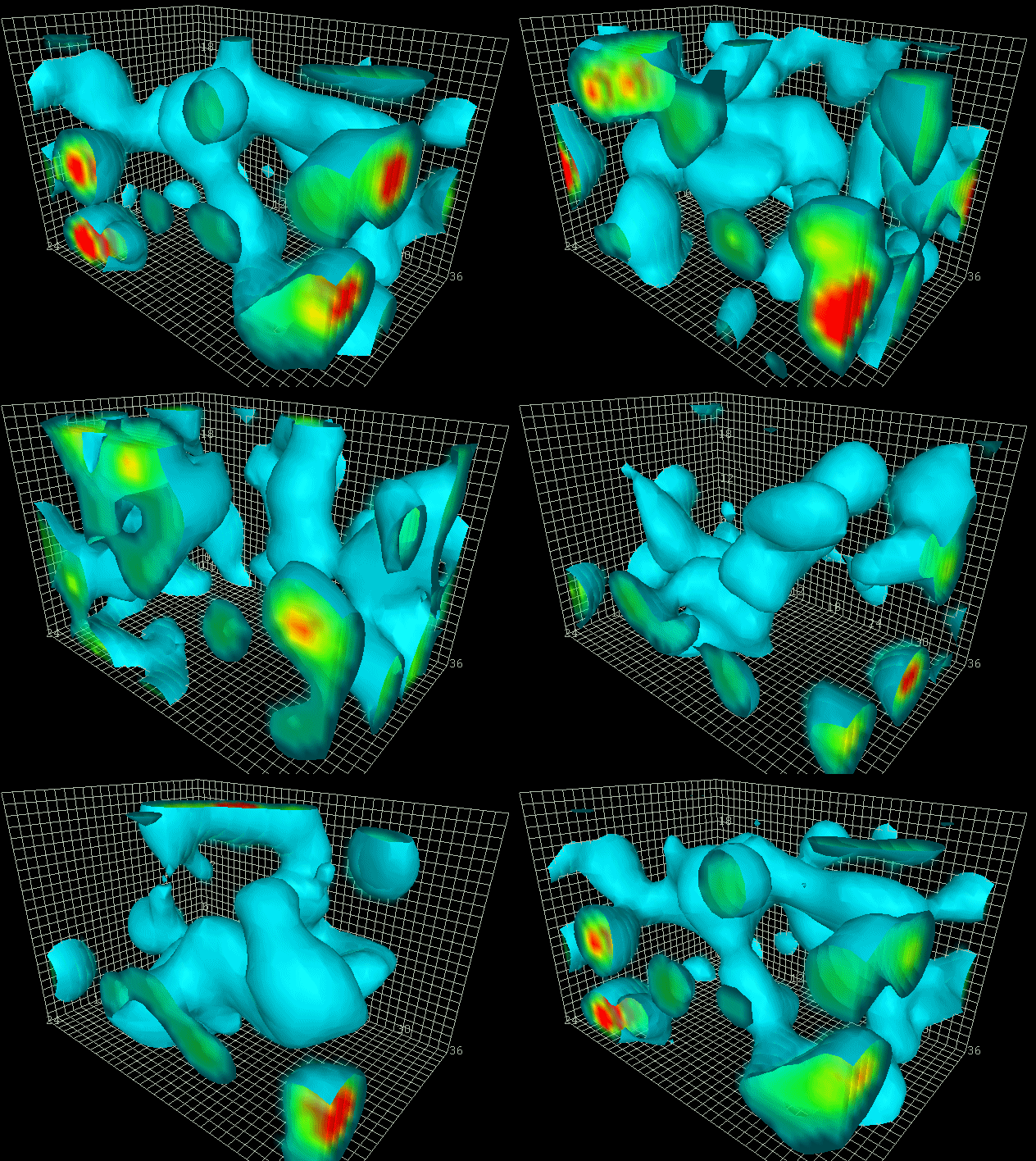
Cosmic String Animation (Credit: Anderson Institute)
This is the QCD String Model “Lava Lamp.” It is an excellent animation of the 4 dimensional structure of the long-distance aspects of the QCD vacuum. (Credit: Derek B. Leinweber)

Dawid argues that the veracity of string theory can be established through philo­sophical and probabilistic arguments about the research process. Citing Bayesian analysis, a statistical method for inferring the likelihood that an explanation fits a set of facts, Dawid equates confirmation with the increase of the probability that a theory is true or viable. But that increase of prob­ ability can be purely theoretical. Because “no­ one has found a good alternative” and “theories without alternatives tended to be viable in the past”, he reasons that string theory should be taken to be valid.

In our opinion, this is moving the goalposts. Instead of belief in a scientific theory increasing when observational evi­dence arises to support it, he suggests that theoretical discoveries bolster belief. But conclusions arising logically from math­ematics need not apply to the real world. Experiments have proved many beauti­ful and simple theories wrong, from the steady ­state theory of cosmology to the SU(5) Grand Uni­fied Theory of par­ticle physics, which aimed to unify the electro-weak force and the strong force. The idea that preconceived truths about the world can be inferred beyond established facts (inductiv­ism) was overturned by Popper and other twentieth­ century philosophers.

We cannot know that there are no alter­ native theories. We may not have found them yet. Or the premise might be wrong. There may be no need for an overarching theory of four fundamental forces and particles if gravity, an effect of space-­time curvature, differs from the strong, weak and electromagnetic forces that govern particles. And with its many variants, string theory is not even well defined: in our view, it is a promissory note that there might be such a unified theory.

MANY MULTIVERSES
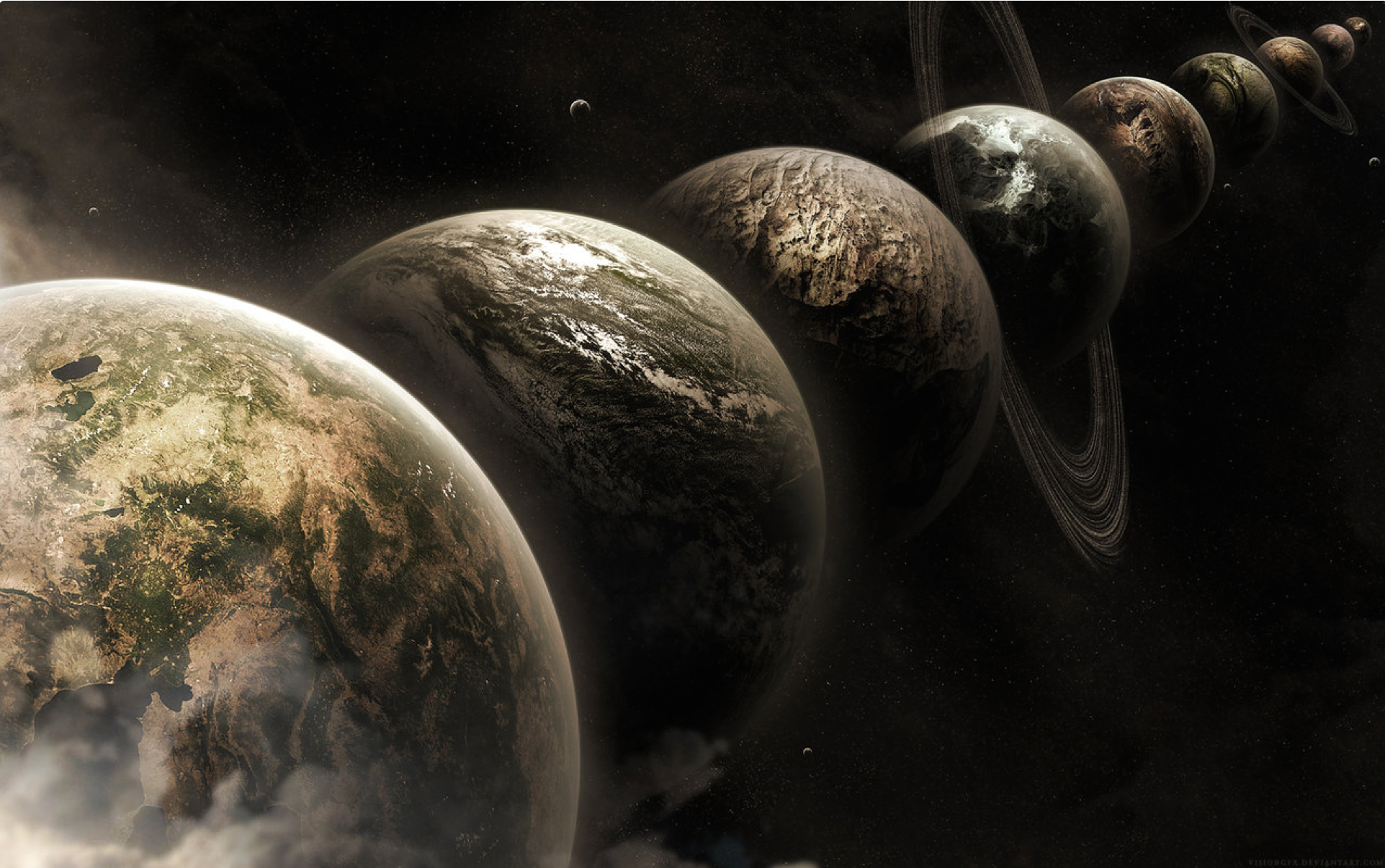
multi
(Credit: Wikipedia)

The multiverse is motivated by a puzzle: why fundamental constants of nature, such as the fine­-structure constant that characterizes the strength of electromagnetic interactions between particles and the cosmological constant associated with the acceleration of the expansion of the Universe, have values that lie in the small range that allows life to exist. Multiverse theory claims that there are billions of unobservable sister universes out there in which all possible values of these constants can occur. So somewhere there will be a bio-­friendly universe like ours, however improbable that is.

Some physicists consider that the multi­verse has no challenger as an explanation of many otherwise bizarre coincidences. The low value of the cosmological constant — known to be 120 factors of 10 smaller than the value predicted by quantum field theory — is difficult to explain, for instance.

Earlier this year, championing the multi­verse and the many­ worlds hypothesis, Carroll dismissed Popper’s falsifiability criterion as a “blunt instrument” (go.nature.com/nuj39z). He offered two other requirements: a scientific theory should be “definite” and “empirical”. By definite, Carroll means that the theory says “something clear and unambiguous about how reality functions”. By empirical, he agrees with the customary definition that a theory should be judged a success or failure by its ability to explain the data.

He argues that inaccessible domains can have a “dramatic effect” in our cosmic back­ yard, explaining why the cosmological con­stant is so small in the part we see. But in multiverse theory, that explanation could be given no matter what astronomers observe. All possible combinations of cosmological parameters would exist somewhere, and the theory has many variables that can be tweaked. Other theories, such as uni-modular gravity, a modified version of Einstein’s general theory of relativity, can also explain why the cosmological constant is not huge.

Some people have devised forms of multi­verse theory that are susceptible to tests: physicist Leonard Susskind’s version can be falsified if negative spatial curvature of the Universe is ever demonstrated. But such a finding would prove nothing about the many other versions. Fundamentally, the multi­ verse explanation relies on string theory, which is as yet unverified, and on speculative mechanisms for realizing different physics in different sister universes. It is not, in our opinion, robust, let alone testable.
Image by Juergen Faelchle / Shutterstock
(Credit: Juergen Faelchle / Shutterstock)

The many-­worlds theory of quantum reality posed by physicist Hugh Everett is the ultimate quantum multiverse, where quantum probabilities affect the mac­roscopic. According to Everett, each of Schrodinger’s famous cats, the dead and the live, poisoned or not in its closed box by random radioactive decays, is real in its own universe. Each time you make a choice, even one as mundane as whether to go left or right, an alternative universe pops out of the quantum vacuum to accommodate the other action.

Billions of universes — and of galaxies and copies of each of us — accumulate with no possibility of communication between them or of testing their reality. But if a duplicate self exists in every multiverse domain and there are infinitely many, which is the real ‘me’ that I experience now? Is any version of oneself preferred over any other? How could ‘I’ ever know what the ‘true’ nature of real­ity is if one self favours the multiverse and another does not?

In our view, cosmologists should heed mathematician David Hilbert’s warning: although infinity is needed to complete mathematics, it occurs nowhere in the physi­cal Universe.

PASS THE TEST

We agree with theoretical physicist Sabine Hossenfelder: post­empirical science is an oxymoron (go.nature.com/p3upwp). Theories such as quantum mechanics and relativity turned out well because they made predictions that survived testing. Yet numerous his­torical examples point to how, in the absence of adequate data, elegant and compelling ideas led researchers in the wrong direction, from Ptolemy’s geocen­tric theories of the cosmos to Lord Kel­vin’s ‘vortex theory’ of the atom and Fred Hoyle’s perpetual steady-­state Universe. [Responce by S. Hossenfelder:  via medium.com]

“Image illustrating a phenomenologist after
reading a philosopher go on about
empiricism.” (Credit: Sabine Hossenfelder at Backreaction)

The consequences of over-claiming the significance of certain theories are pro­ found — the scientific method is at stake (go.nature.com/hh7mm6). To state that a theory is so good that its existence supplants the need for data and testing in our opinion risks misleading students and the public as to how science should be done and could open the door for pseudoscientists to claim that their ideas meet similar requirements.

What to do about it? Physicists, philosophers and other scientists should hammer out a new narrative for the sci­entific method that can deal with the scope of modern physics. In our view, the issue boils down to clarifying one question: what potential observational or experimental evidence is there that would persuade you that the theory is wrong and lead you to abandoning it? If there is none, it is not a scientific theory.

Such a case must be made in formal philosophical terms. A conference should be convened next year to take the first steps. People from both sides of the testability debate must be involved.
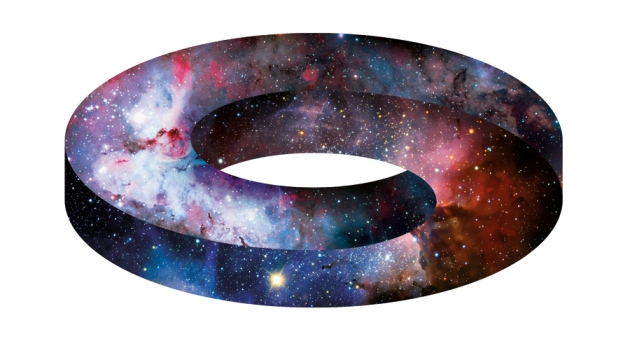
(Credit: Unknown)
(Credit: Vasava)

In the meantime, journal editors and publishers could assign speculative work to other research categories — such as mathematical rather than physical cos­mology — according to its potential testability. And the domination of some physics departments and institutes by such activities could be rethought.

The imprimatur of science should be awarded only to a theory that is testable. Only then can we defend science from attack.

Listen to Physicists Brian Green, professor of mathematics and physics, Columbia University, and Lee Smolin, faculty member, Perimeter Institute for Theoretical Physics Debate the Merits of String Theory (via NPR):

George Ellis is professor emeritus of applied mathematics at the University of Cape Town, South Africa.
Joe Silk is professor of physics at the Paris Institute of Astrophysics, France, and at Johns Hopkins University in Baltimore, Maryland, USA.

Copyright © 2014, Rights Managed by Nature Publishing Group, Permission to re-print license: 3531500151649

The Higgs and Beyond

Excerpt from: The Standard Model of Particle Physics by Tom W.B. Kibble

(Credit: particleadventure.org)

This may seem a very strange theory but it is now well established; QCD and the electroweak theory together constitute the standard model, with spin -½ leptons and quarks and spin – 1 gauge bosons. It has been tested by innumerable experiments over the last forty years and been thoroughly vindicated.

Until recently there was however a gap, the Higgs boson. Back in 1964, the existence of this extra particle was seen as a relatively minor feature; the important thing was the mechanism for giving masses to gauge bosons. But twenty years later, it began to assume a special significance as the only remaining piece of the standard – model jigsaw that had not been found.

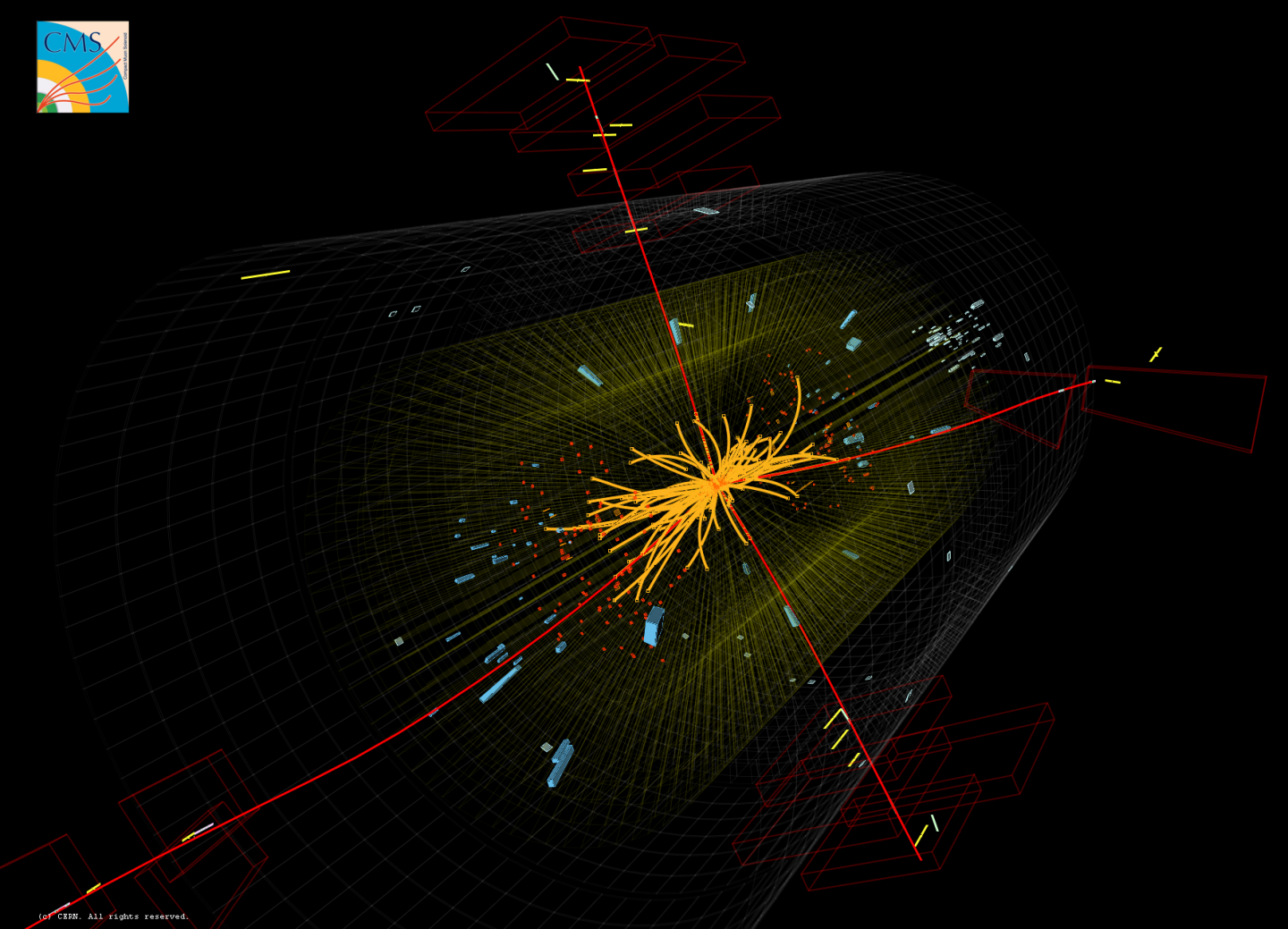
Real CMS proton-proton collision events in which 4 high energy muons (red lines) are observed. The event shows characteristics expected from the decay of a Higgs boson but is also consistent with background Standard Model physics processes. (Credit: CERN, for the benefit of the CMS Collaboration)

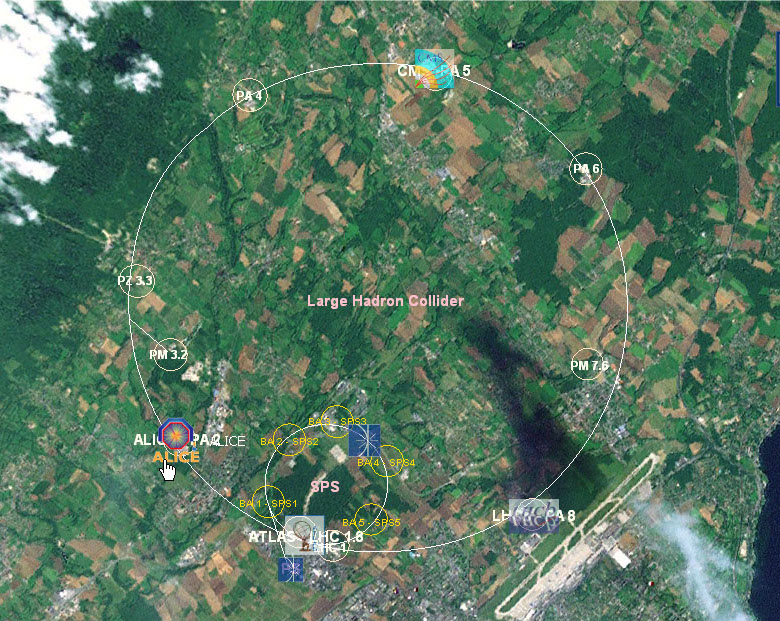
Finding it was one of the principal goals of the large hadron collider (LHC) at CERN. This is the largest piece of scientific apparatus every constructed, a precision instrument built in a huge 27 km – long tunnel straddling the French – Swiss border near Geneva — a truly remarkable piece of engineering. Protons are sent round in both directions, accelerated close to the speed of light, and allowed to collide at four crossing points around the ring. At two of these are large detectors, Atlas and CMS, also marvels of engineering, that over a period of twenty years have been designed, built and operated by huge international teams of physicists and engineers. In 2012 this mammoth effort paid off, with the unequivocal discovery by both teams of the Higgs boson.

Aerial of Cern (Credit: CERN / LHC)

So is this the end of the story? Surely not. The standard model can hardly be the last word.

It is marvelously successful, but far from simple. It has something like 20 arbitrary parameters, things like ratios of masses and coupling strengths, that we cannot predict and that seem to have no obvious pattern to them. Moreover there are many features for which  we have no explanation. Why for both quarks and leptons are there three generations with very similar properties but wildly varying masses? Why do quarks come in three colours?

One theory is that all these choices are random. There may have been many big bangs, each producing a universe with its own set of parameters. Most of those universes would probably be devoid of life. But that is for many a profoundly unsatisfactory answer; we certainly hoped for a more predictive theory!

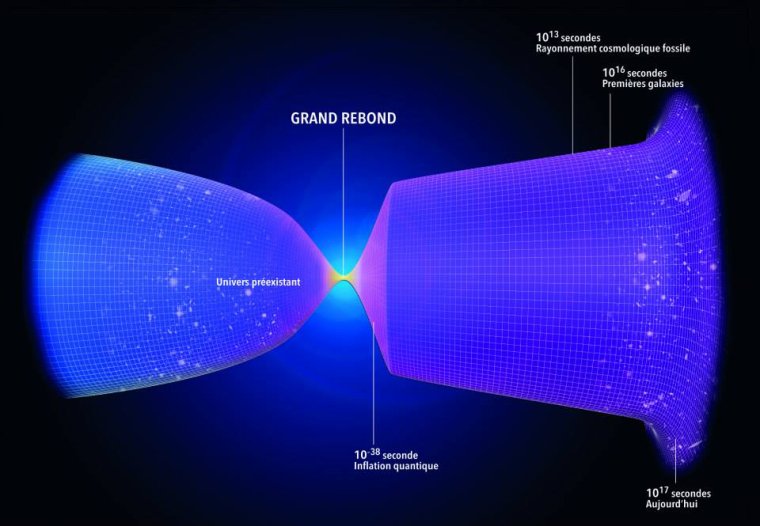
Grand Rebound (Credit: Unknown)

On the observational side, there are still many things we cannot explain. What is the nature of the dark matter in the universe? Why does the universe contain more matter than antimatter — leptons and quarks rather than antileptons and antiquarks? Moreover there are a few points on which the standard model definitely does not agree with observation. In particular, in the standard model the neutrinos are strictly massless. But we now know that do in fact have non-zero, albeit very tiny, masses. We really have no idea why.

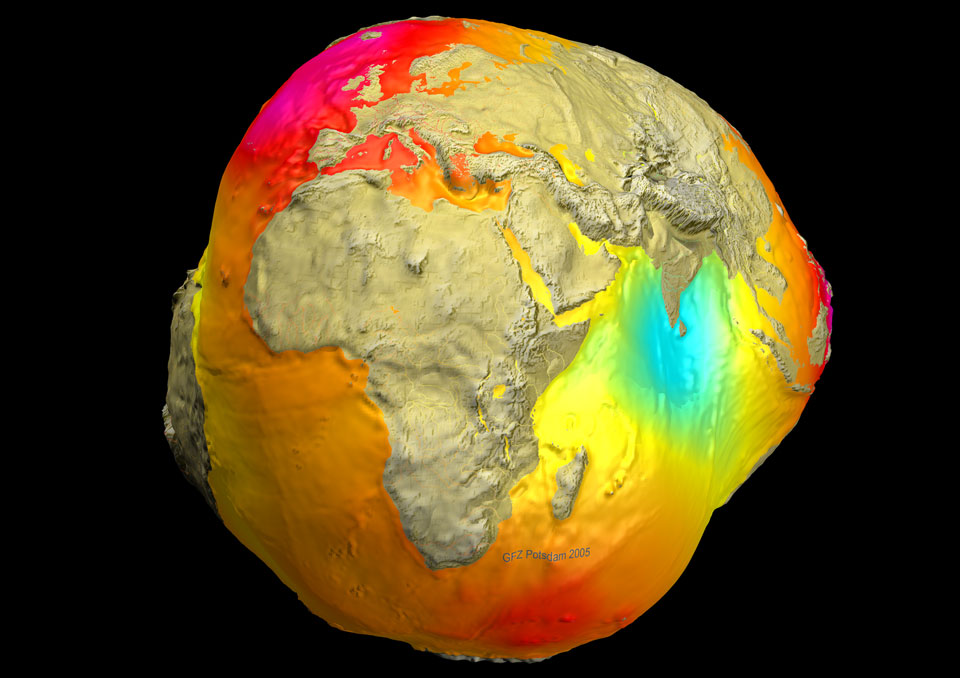
The slight difference in the gravity of Earth in different locations illustrated. (Credit: NASA)

Finally, there is the elephant in the room: gravity, which does not appear at all in the standard model. It is in fact very difficult to reconcile our best theory of gravity, Einstein’s general theory of relativity, with quantum theory. That is a problem we have been struggling with for the best part of a century. There are hopes that string theory, or its more modern realization, M-theory, may successfully unite the two, but that effort has been going on for decades without as yet reaching a conclusion. At any rate it does appear that there is a lot more for theoretical physicists to do!

Excerpt from: The Standard Model of Particle Physics by Tom W.B. Kibble. Blackett Laboratory, Imperial College London  arXiv:1412.4094 (PDF)

Have Experimentalists Discovered Dark Matter?

3D map of the large-scale distribution of dark matter, reconstructed from measurements of weak gravitational lensing with the Hubble Space Telescope (Credit: Wikipedia)

Scientists have long known that dark matter is out there, silently orchestrating the universe’s movement and structure. But what exactly is dark matter made of? And what does a dark matter particle look like? That remains a mystery, with experiment after experiment coming up empty handed in the quest to detect these elusive particles.

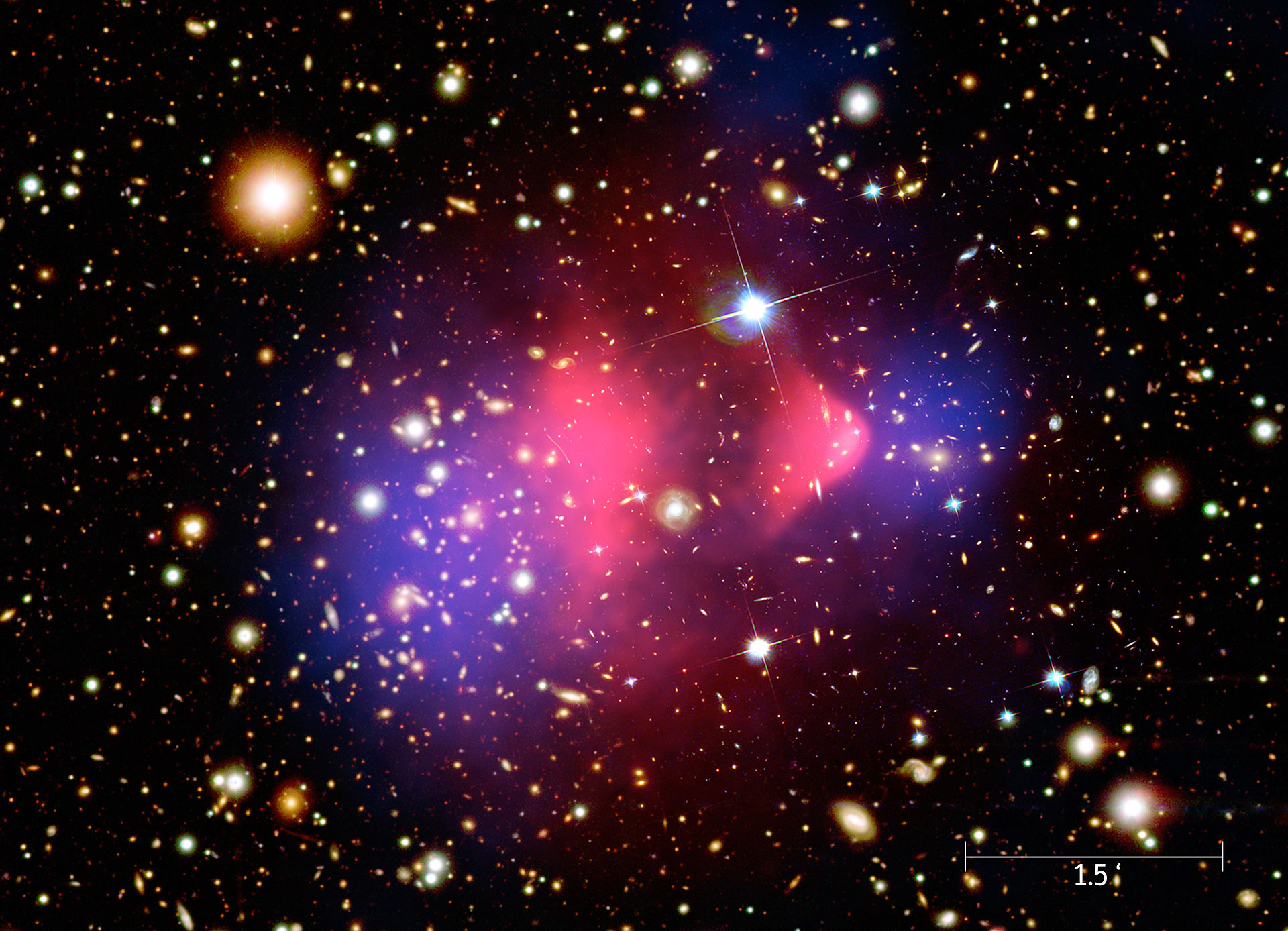
The Bullet Cluster: HST image with overlays. The total projected mass distribution reconstructed from strong and weak gravitational lensing is shown in blue, while the X-ray emitting hot gas observed with Chandra is shown in red. (Credit: Wikipedia)

With some luck, that may be about to change. With ten times the sensitivity of previous detectors, three recently funded dark matter experiments have scientists crossing their fingers that they may finally glimpse these long-sought particles. In recent conversations with The Kavli Foundation, scientists working on these new experiments expressed hope that they would catch dark matter, but also agreed that, in the end, their success or failure is up to nature to decide.

Read the Transcript: Kavil Foundation Dark Matter Transcript

“Nature is being coy,” said Enectali Figueroa-Feliciano, an associate professor of physics at the MIT Kavli Institute for Astrophysics and Space Research who works on one of the three new experiments. “There’s something we just don’t understand about the internal structure of how the universe works. When theorists write down all the ways dark matter might interact with our particles, they find, for the simplest models, that we should have seen it already. So even though we haven’t found it yet, there’s a message there, one that we’re trying to decode now.”

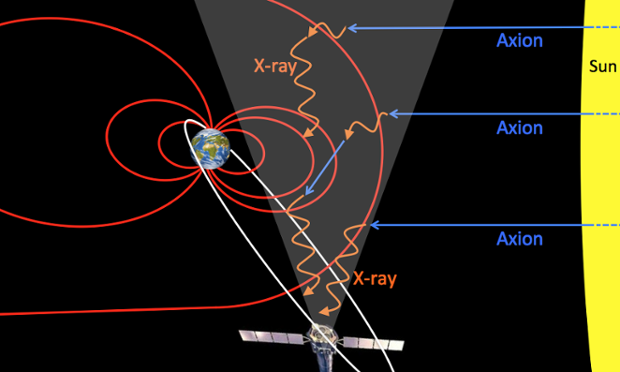
Dark matter particles known as axions streaming from the sun, converting in Earth’s magnetic field (red) to x-rays, which are detected by the XMM-Newton observatory. (Credit: University of Leicester)

The first of the new experiments, called the Axion Dark Matter eXperiment, searches for a theoretical type of dark matter particle called the axion. ADMX seeks evidence of this extremely lightweight particle converting into a photon in the experiment’s high magnetic field. By slowly varying the magnetic field, the detector hunts for one axion mass at a time.

“We’ve demonstrated that we have the tools necessary to see axions,” said Gray Rybka, research assistant professor of physics at the University of Washington who co-leads the ADMX Gen 2 experiment. “With Gen2, we’re buying a very, very powerful refrigerator that will arrive very shortly. Once it arrives, we’ll be able to scan very, very quickly and we feel we’ll have a much better chance of finding axions – if they’re out there.”

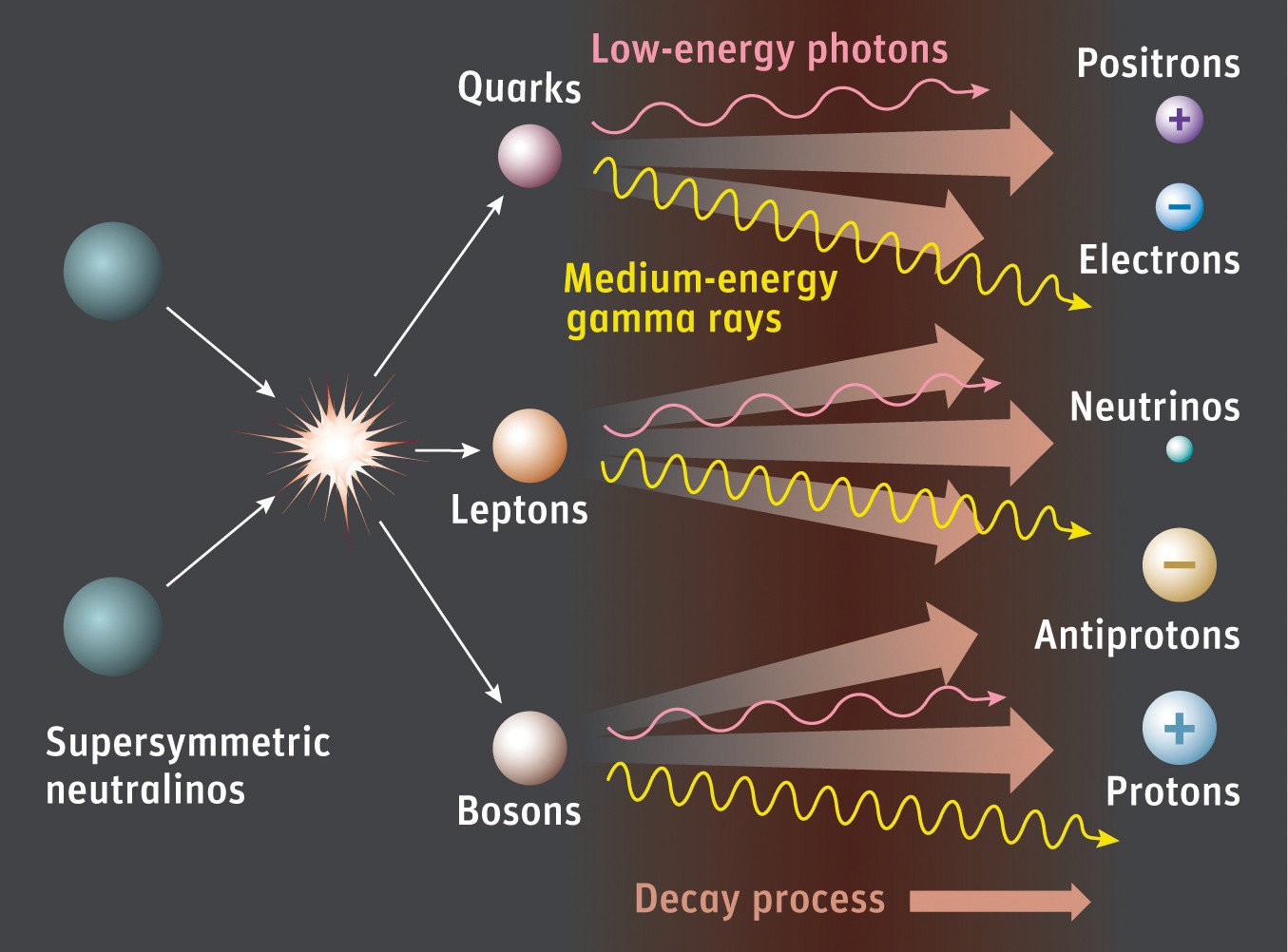
According to supersymmetry, dark-matter particles known as neutralinos (aka WIMPs) annihilate each other, creating a cascade of particles and radiation. (Credit: Sky & Telescope / Gregg Dinderman)

The two other new experiments look for a different type of theoretical dark matter called the WIMP. Short for Weakly Interacting Massive Particle, the WIMP interacts with our world very weakly and very rarely. The Large Underground Xenon, or LUX, experiment, which began in 2009, is now getting an upgrade to increase its sensitivity to heavier WIMPs. Meanwhile, the Super Cryogenic Dark Matter Search collaboration, which has looked for the signal of a lightweight WIMP barreling through its detector since 2013, is in the process of finalizing the design for a new experiment to be located in Canada.

“In a way it’s like looking for gold,” said Figueroa-Feliciano, a member of the SuperCDMS experiment. “Harry has his pan and he’s looking for gold in a deep pond, and we’re looking in a slightly shallower pond, and Gray’s a little upstream, looking in his own spot. We don’t know who’s going to find gold because we don’t know where it is.”

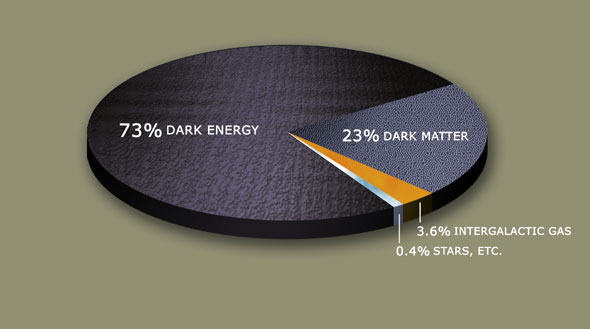
Astronomers use the idea of dark matter to account for a substantial portion of the mass of our universe. An even greater amount of mass, they believe, is taken up with dark energy. Meanwhile, the visible stars and galaxies we see around us in space may be only a small part of the whole universe. (Credit: Wikimedia Commons.)

Rybka agreed, but added the more optimistic perspective that it’s also possible that all three experiments will find dark matter. “There’s nothing that would require dark matter to be made of just one type of particle except us hoping that it’s that simple,” he said. “Dark matter could be one-third axions, one-third heavy WIMPs and one-third light WIMPs. That would be perfectly allowable from everything we’ve seen.”

Yet the nugget of gold for which all three experiments search is a very valuable one. And even though the search is difficult, all three scientists agreed that it’s worthwhile because glimpsing dark matter would reveal insight into a large portion of the universe.

"Cold Dark Matter: An Exploded View" Art Print by Cornelia Parker.  An artistic interpretation of Dark Matter. (Credit: Cornelia Parker)
“Cold Dark Matter: An Exploded View” Art Print by Cornelia Parker. An artistic interpretation of Dark Matter. (Credit: Cornelia Parker)

“We’re all looking and somewhere, maybe even now, there’s a little bit of data that will cause someone to have an ‘Ah ha!’ moment,” said Harry Nelson, professor of physics at the University of California, Santa Barbara and science lead for the LUX upgrade, called LUX-ZEPLIN. “This idea that there’s something out there that we can’t sense yet is one of those things that sends chills down my spine.”

Via: Kavi Institute


Have Yourself a Merry Little Meteor

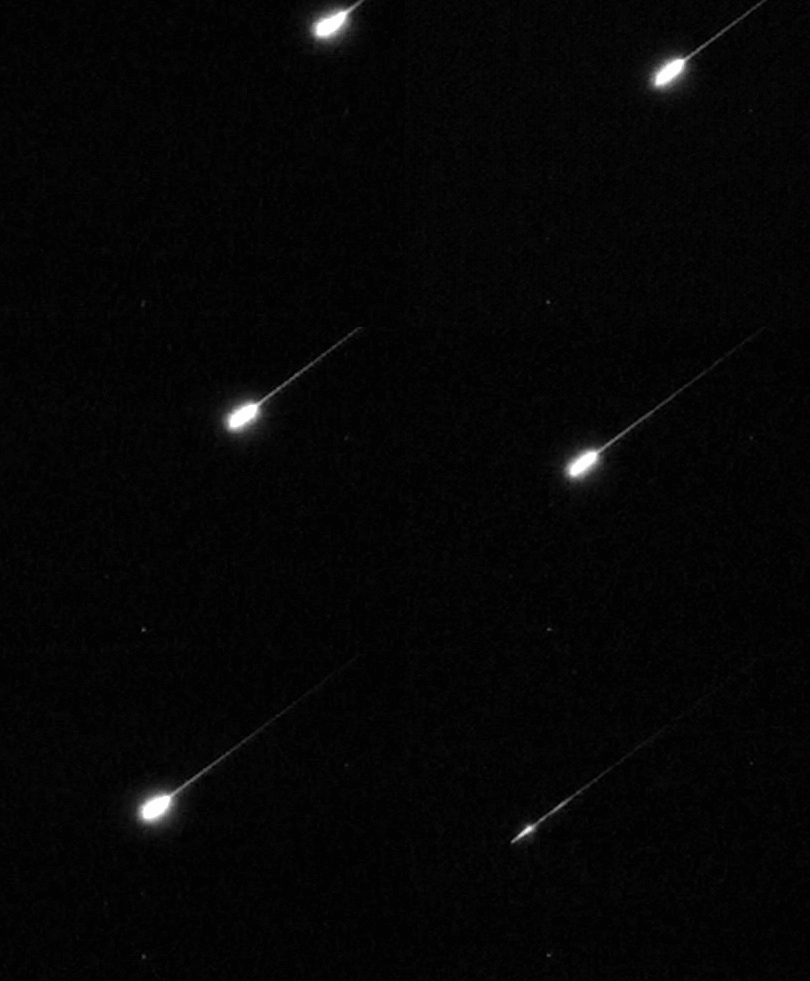
The annual Geminid meteor shower peaks on December 13/14 and as expected it displayed a fascinating show in 2009. (Credit:  Babak A. Tafreshi, TWANight)
The annual Geminid meteor shower peaks on December 13/14 and as expected it displayed a fascinating show in 2009. (Credit: Babak A. Tafreshi, TWANight)

“The Geminids are expected to peak just before dawn on Dec. 14, with a predicted peak rate of 100 to 120 meteors per hour,” reports NASA.  Unlike most other meteor showers, the Geminids are not associated with a comet but rather the asteroid, 3200 Phaethon, which is thought to be a Palladian asteroid with a “rock comet” orbit.  This would make the Geminids, together with the Quadrantids, the only major meteor showers not originating from a comet.  The asteroid takes about 1.4 years to orbit around the Sun.  (Credit: Wikipedia, Earth Sky, NASA)

Listen to Live Meteor Radar Echoes: http://topaz.streamguys.tv/~spaceweather/

Watch the Ustream feed from a telescope at Marshall Space Flight Center:

The Marshall Space Flight Center will host an overnight NASA web chat on Dec. 13 from 10 p.m. to 2 a.m. CST.  Join the chat at: http://www.nasa.gov/connect/chat/geminids_2014.html

Last December, Jason Hullinger went to Joshua Tree National Park to catch the Geminid meteor shower. He set up his tripod to take 20-second exposures from about 11 p.m. Thursday to 3 a.m. Friday. (Credit: Jason Hullinger)

The Geminids are considered to be one of the more spectacular meteor showers of the year!

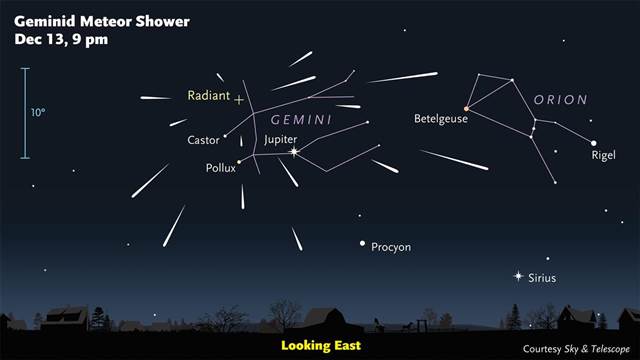
Geminid meteors appear to emanate from a radiant point in the constellation Gemini, as shown in this sky chart. (Credit: Sky and Telescope)

Book Announcement

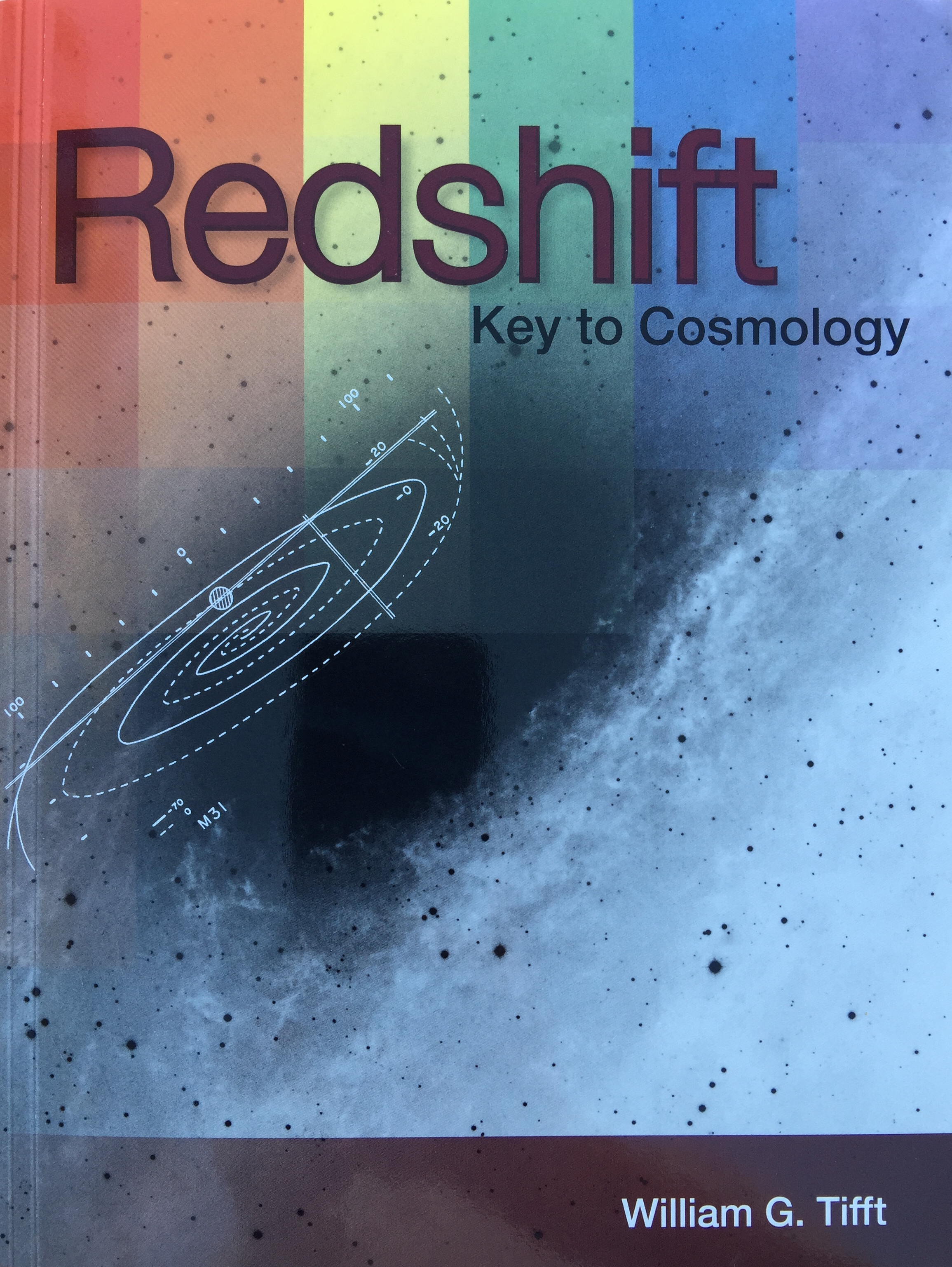
Effective February 1, 2015 my book “Redshift Key to Cosmology”, which will be used in topical discussions within this blog in addition to the ASP preprint “The Nature of the Redshift” has been published and is available for purchase. For buyers who would like to provide some support to Lowell Observatory, one of the great private astronomical institutions where my professional work began, the book (only the paperback version) may be purchased or ordered from the Starry Skies Shop at Lowell Observatory (US only). Contact Diana Weintraub at dweintraub@lowell.edu or (928) 233-3206. A catalog featuring the book with a brief description is currently being completed and will soon be available on the Lowell Observatory website, at which time a link will be provided to access the online catalog.

For persons in or passing through Tucson, Arizona the book may be purchased at (but not ordered from) AlphaGraphics stores located at 7306 N. Oracle Rd., or 4811 E Grant Rd. The 460 page book may also be ordered through Amazon with standard domestic or international shipping. Paperback is $40, hardcover $99. Illustrations and basic descriptions are provided.

William Grant Tifft
SASTPC Principle Scientist