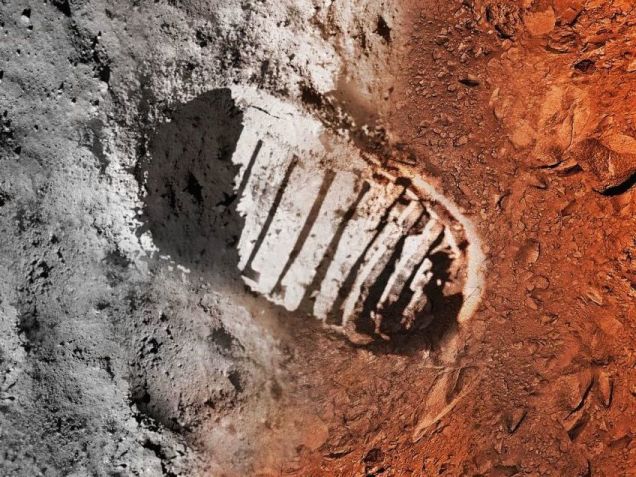
Every once in a while I think that there maybe is no fundamentally smallest unit of length; that all these arguments for its existence are wrong. I like to think that we can look infinitely close into structures and will never find a final theory, turtles upon turtles, or that structures are ultimately self-similar and repeat.(Credit: Sabine Hossenfelder, Sanghyuk Moon)
via medium
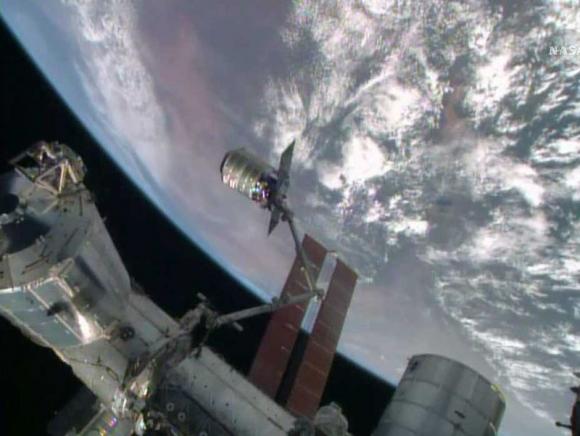
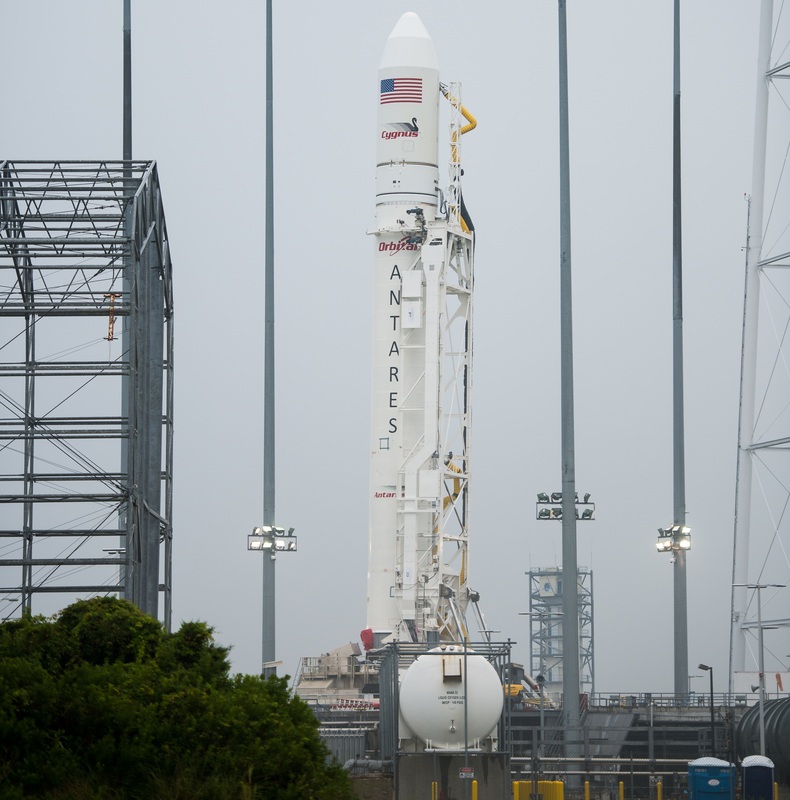
The International Space Station’s robotic arm, Canadarm2, grapples the Orbital Sciences’ Cygnus cargo craft, as seen in this still image taken from NASA TV July 16, 2014. (Credit: Reuters/NASA TV/Handout via Reuters)
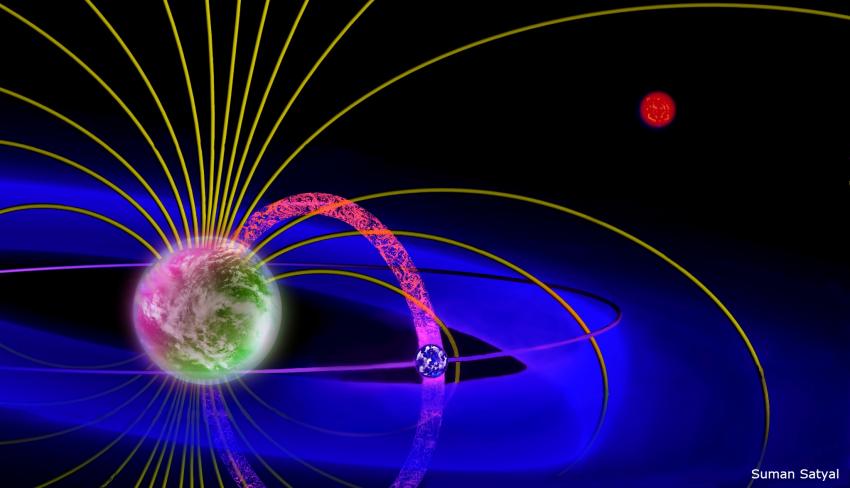
This is a schematic of a plasma torus around an exoplanet, which is created by the ions injected from an exomoon’s ionosphere into the planet’s magnetosphere. (Credit: UT Arlington)
“As NASA continues to push the boundaries of human imagination and innovation, we have seen the value in utilizing a citizen-based professional crowd to complement our internal efforts and solve complex real-world challenges,” Jason Crusan, director of NASA’s Tournament Lab. (Credit: NASA/Don Davis)
via motherboard
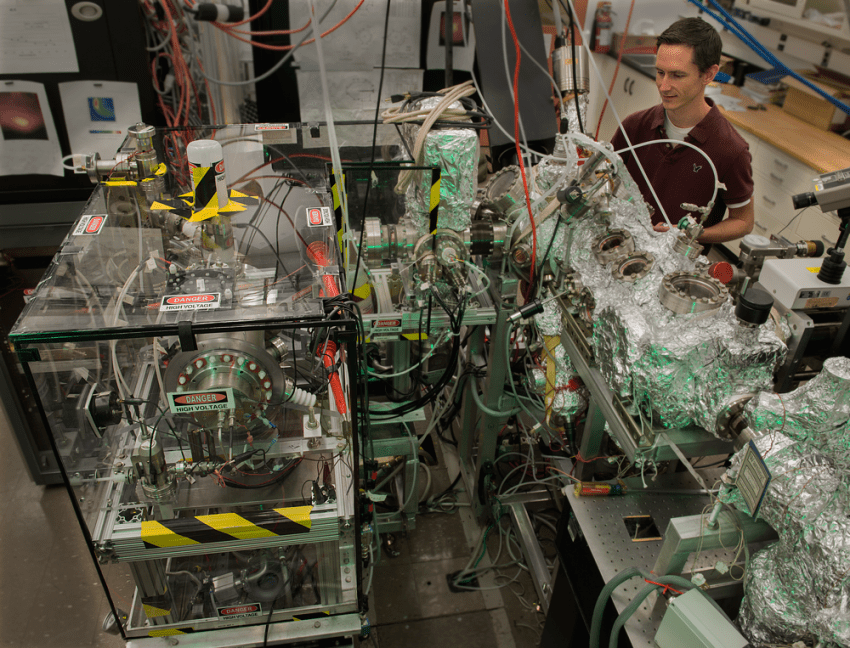
NIST researcher Kevin Dwyer with the silicon enrichment apparatus. The process begins at the left, where natural-abundance silicon in the form of silane gas (SiH4) is ionized. The ions pass through a magnetic field (top left), which causes their paths to curve to different degrees based on their mass. The silicon-28 ions, now separated from the other silicon isotopes, are decelerated through an ultra-high vacuum chamber (top center) and into the deposition chamber (top right) (Credit: Pomeroy, NIST, Dwyer)
via phys
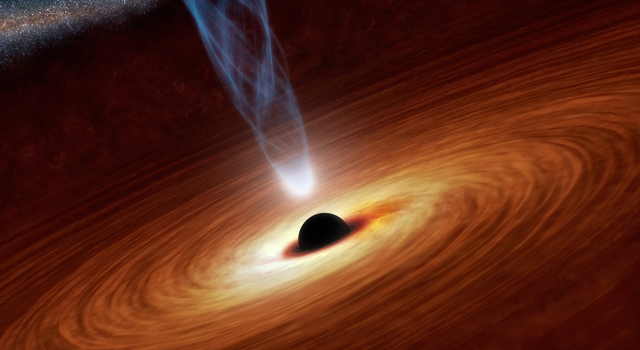
This artist’s concept illustrates a supermassive black hole with millions to billions times the mass of our sun. Supermassive black holes are enormously dense objects buried at the hearts of galaxies. (Credit: NASA/JPL-Caltech)
via pasadenanow
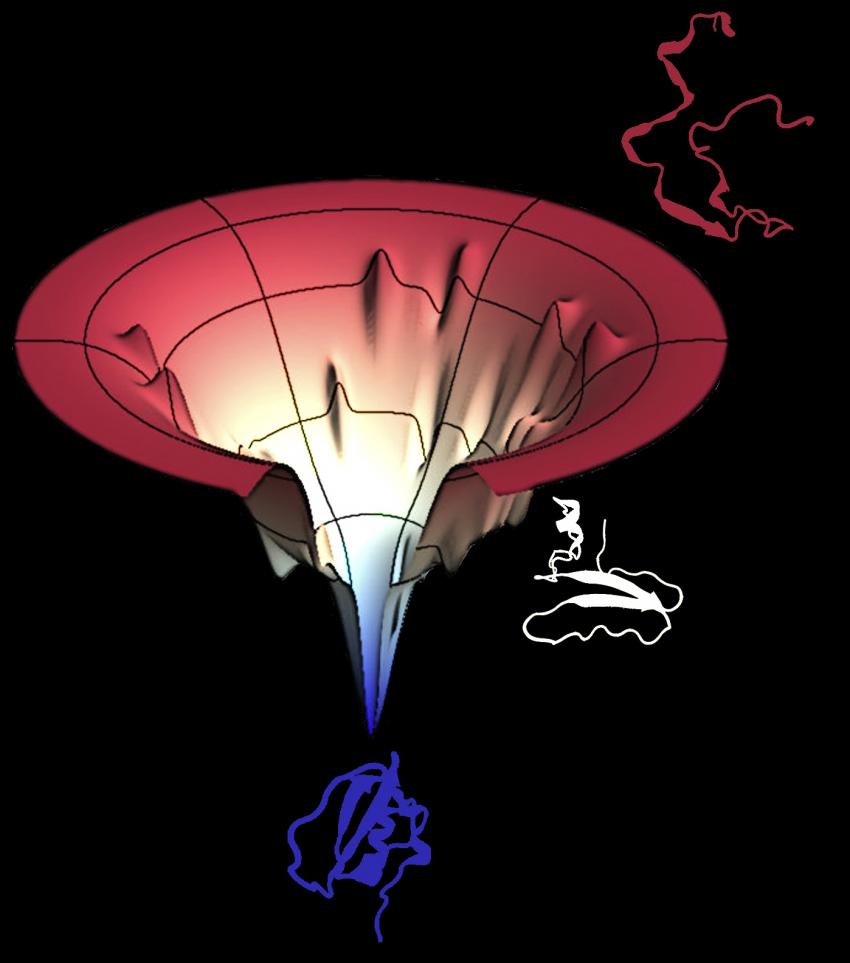
A protein folding funnel, the product of algorithms created by Rice’s Center for Theoretical Biological Physics, is a graphic representation of the energy landscape a protein navigates as it goes from its initial floppy state to a folded, functional unit. The funnel shows smooth slopes as well as outcroppings where parts of a protein may pause while others catch up, and also traps that could cause a protein to misfold. New Rice research shows how the interplay between evolution and physics developed the skills necessary to conserve useful proteins. (Credit: Center for Theoretical Biological Physics/Rice University)
via phys
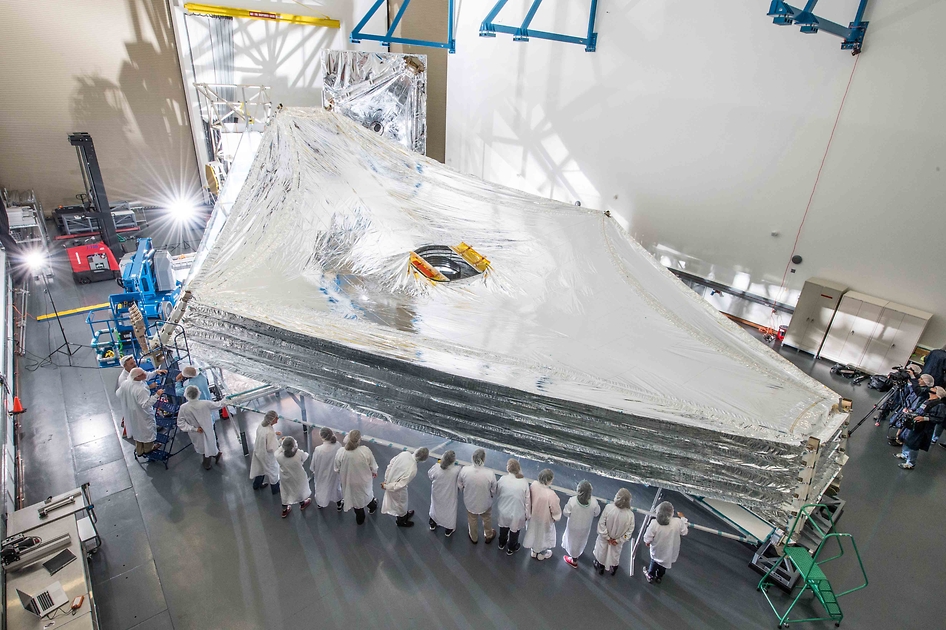
The James Webb Space Telescope (sometimes called JWST) is an orbiting infrared observatory that will complement and extend the discoveries of the Hubble Space Telescope, with longer wavelength coverage and greatly improved sensitivity.(Credit: NASA/Chris Gunn)
via nasa
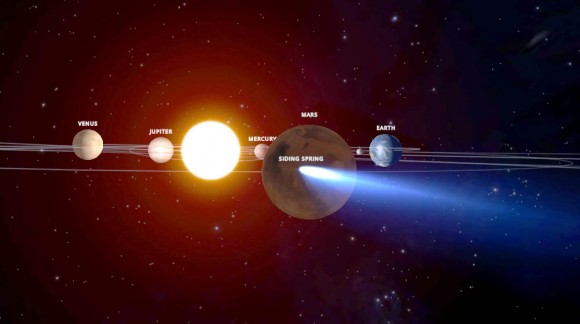
Simulation depicts comet C/2013 A1 Siding Spring during its close Mars flyby on Oct. 19. Its nucleus will miss Mars by about 82,000 miles (132,000 kilometers). The comet’s trail of dust particles shed by the nucleus might be wide enough to reach the planet. Click to see the interactive, animated view. (Credit: Solarsystemscope.com)
via universetoday
Justin Dowd, a Princeton man who won a contest and will be traveling into outer space next year, sits next to an illustration used in the opening scene of his educational video. (Credit: T&G Staff/STEVE LANAVA)
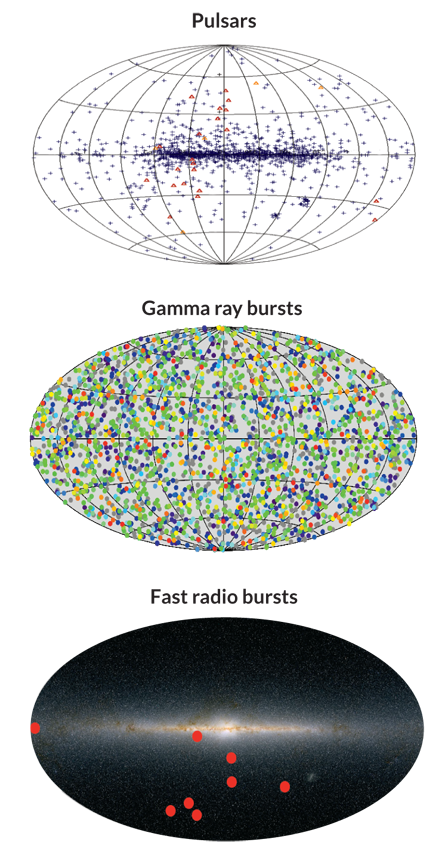
Mapping signals on the sky can offer clues about where the signals originate. Pulsars (top) concentrate in the Milky Way, because most of the ones we see sit in our galaxy. Gamma bursts (middle) come from everywhere, which means they’re parked in other galaxies. Fast radio bursts (bottom) seem to mostly avoid our galgaxy, a hint that they may come from very far away.(Credits: Green Bank Telescope, West Virginia Univ; G. Fishman et al/BATSE, CGRO, NASA.; J. Carpenter, T.H. Jarrett/2MASS, R. Hurt, C. Crockett)
via sciencenews
Evidence of gravitational waves in the infant universe may have been uncovered by the BICEP2 radio telescope. (Credit: NASA/JPL-Caltech)
via uncommondescent
The first Giant Leap was Apollo 11 landing astronauts on the moon. The next Giant Leap could be Apollo 45 landing humans on Mars. (Credit: NASA)
via io9
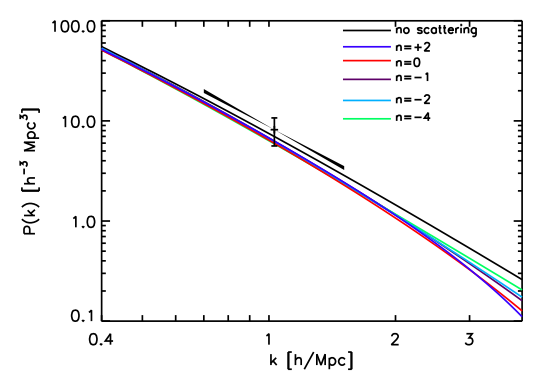
The colored curves describe different velocity dependencies of the scattering strength; it is scaling as v to the nth power. The horizontal axis, k, is a measure of how separated two points in space might be; larger k corresponds to smaller physical separation. The vertical axis (technically known as a “power spectrum”) describes how correlated two points separated by a scale 1/k are; higher number mean more correlation. The one point with error bars shows that most of the models the authors consider are not very favored by the data. (Credit: C. Dvorkin, K. Blum, and M. Kamionkowski)
via astrobites
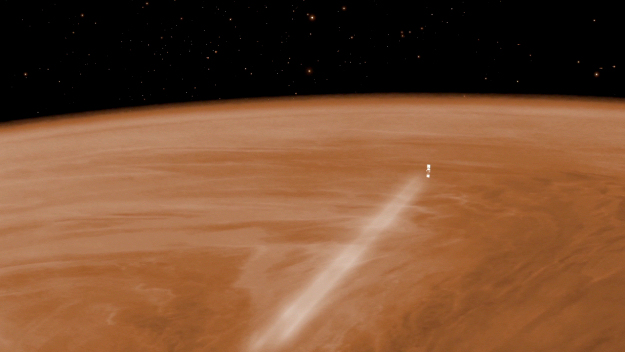
After a month surfing in and out of the atmosphere of Venus down to just 130 km from the planet’s surface, ESA’s Venus Express is about to embark on a 15 day climb up to the lofty heights of 460 km. (Credit: ESA – C. Carreau)
via esa
Chao-Lin Kuo, who helped design the BICEP2 experiment, isn’t bothered by criticism that cosmic dust may account for his results. He just wants to know the truth. (Credit: Chao-Lin Kuo)
via scientificamerican
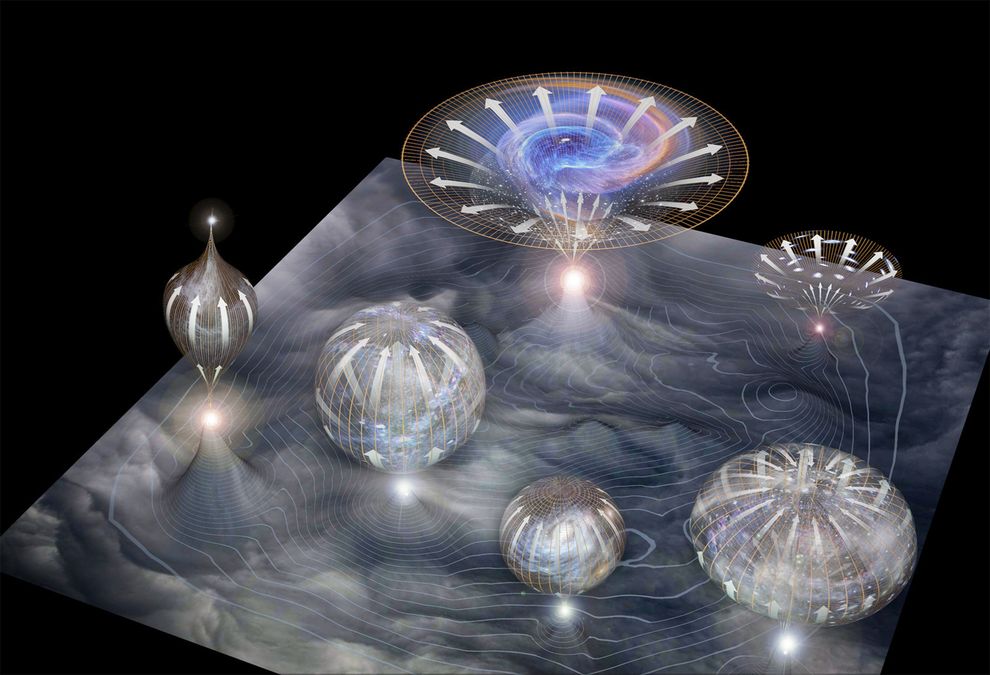
This illustration depicts a main membrane out of which individual universes arise; they then expand in size through time. (Credit: Moonrunner Design)
via scienceblogs
Researchers at Washington State University have used a super-cold cloud of atoms that behaves like a single atom to see a phenomenon predicted 60 years ago and witnessed only once since.
via scientificcomputing.com
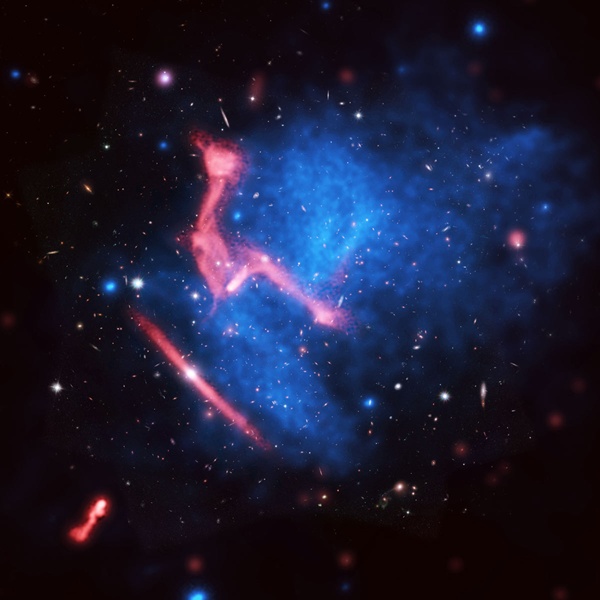
Colliding galaxy clusters MACS J0717+3745, more than 5 billion light-years from Earth. Background is Hubble Space Telescope image; blue is X-ray image from Chandra, and red is VLA radio image.
via www.astronomy.com
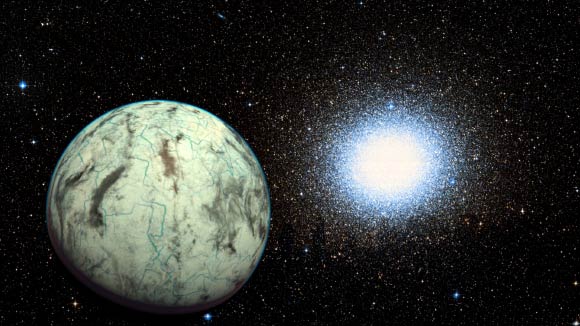
This artistic representation shows the potentially habitable exoplanet Kapteyn b and the globular cluster Omega Centauri in the background. It is believed that this cluster is the remaining core of a dwarf galaxy that merged with our own Milky Way Galaxy billions of years ago bringing Kapteyn’s star along. Image credit: PHL / UPR Arecibo / Aladin Sky Atlas.
via www.sci-news.com
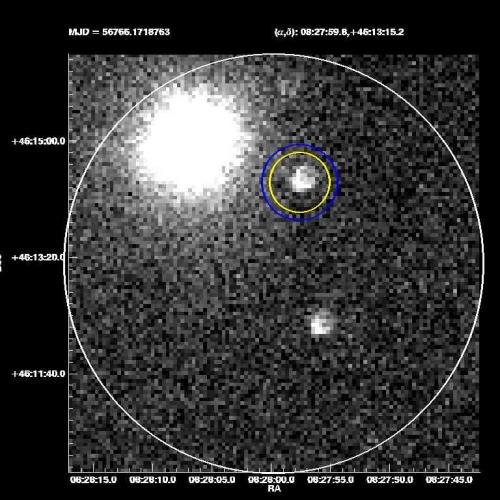
Light from the explosion 12 billion years ago of a massive star at the end of its life reached Earth recently. An image of its peak afterglow, circled with blue and yellow, was captured by Southern Methodist University’s ROTSE-IIIb telescope at McDonald Observatory, Fort Davis, Texas. A bright star sits alongside the afterglow from GRB 140419A. Credit: ROTSE-IIIb, SMU
via phys.org
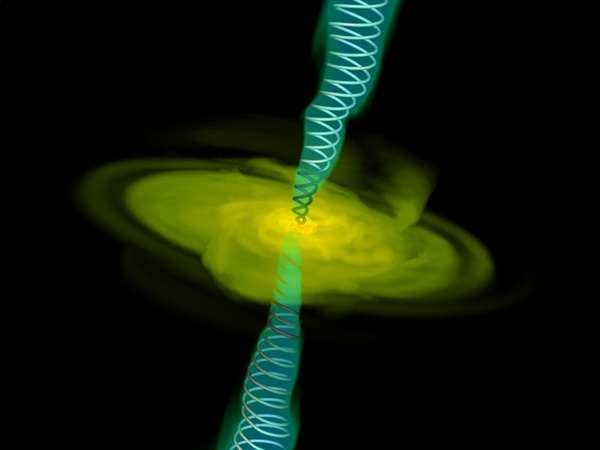
A computer simulation of gas (in yellow) falling into a black hole (too small to be seen). Twin jets are also shown with magnetic field lines. Alexander Tchekhovskoy (LBNL)
via www.astronomy.com
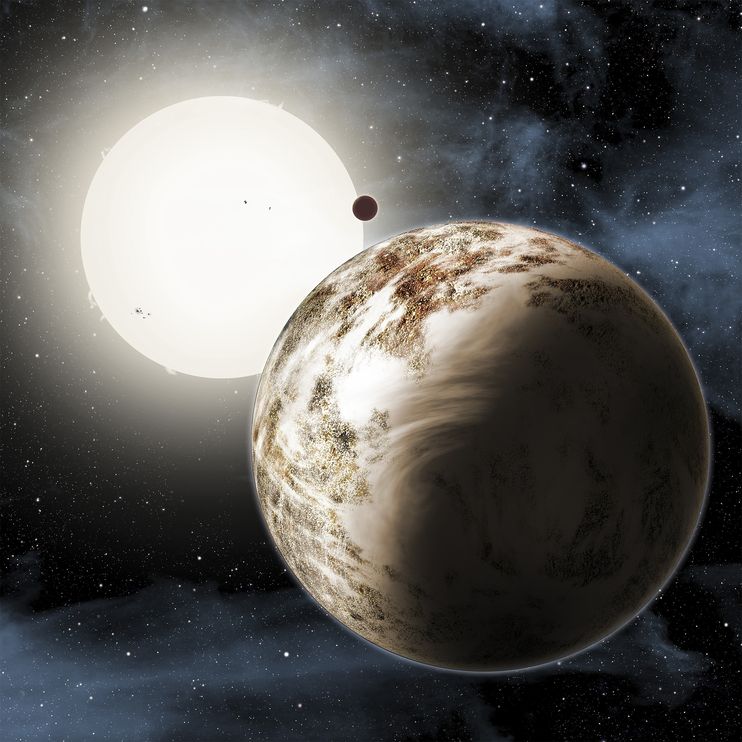
Rocky world could be the first of an entirely new class of planet. An illustration of mega-Earth Rocky world could be the first of an entirely new class of planet. An illustration of mega-Earth The newly discovered ”mega-Earth” Kepler-10c dominates the foreground in this artist’s conception released by the Harvard-Smithsonian Center for Astrophysics in Cambridge, Massachusetts on June 2, 2014.
via news.nationalgeographic.com
Penn astrophysicist Mark Devlin and Jackie Tileston, an associate professor of fine arts at PennDesign, collaborated on the ARTacama Project, the “highest known art installation in the world” three miles above sea level in the Chilean mountains.www.upenn.edu