Professor Michael Barnsley with a fractally transformed teacup and pot. (Credit: Phil Dooley, ANU)
An ANU mathematician has developed a new way to uncover simple patterns that might underlie apparently complex systems, such as clouds, cracks in materials or the movement of the stockmarket.
“Fractal Geometry is a new branch of mathematics that describes the world as it is, rather than acting as though it’s made of straight lines and spheres. There are very few straight lines and circles in nature. The shapes you find in nature are rough.” said Michael Barnsley, Professor of Mathematics at ANU.
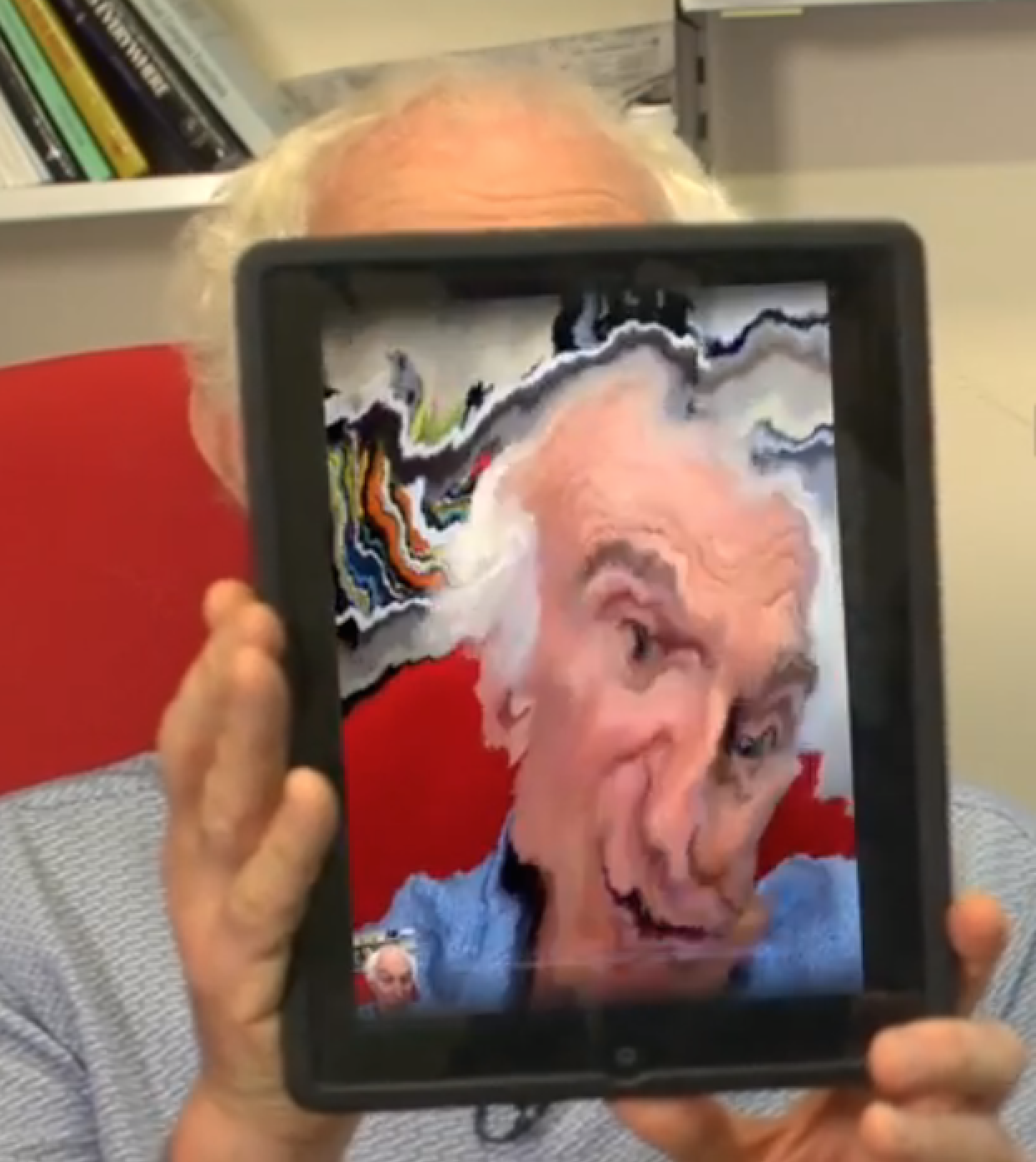
FrangoCamera App developed at ANU. (Credit ANU)
“Fractal Fourier analysis provides a method to break complicated signals up into a set of well understood building blocks, in a similar way to how conventional Fourier analysis breaks signals up into a set of smooth sine waves,” said Professor Michael Barnsley, who who presented his work at the New Directions in Fractal Geometry conference.
“There are terrific advances to be made by breaking loose from the thrall of continuity and differentiability…The body is full of repeating branch structures – the breathing system, the blood supply system, the arrangement of skin cells, even cancer is a fractal.”
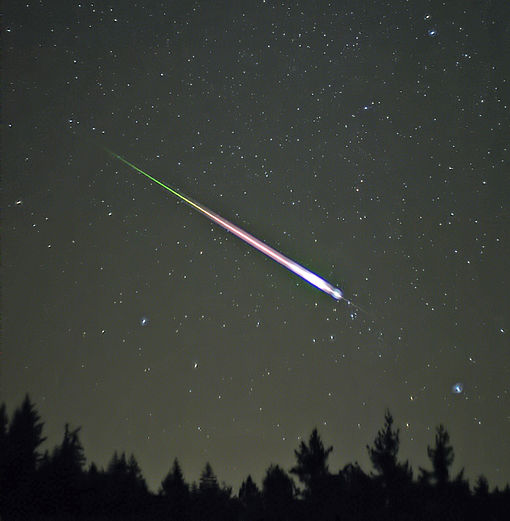
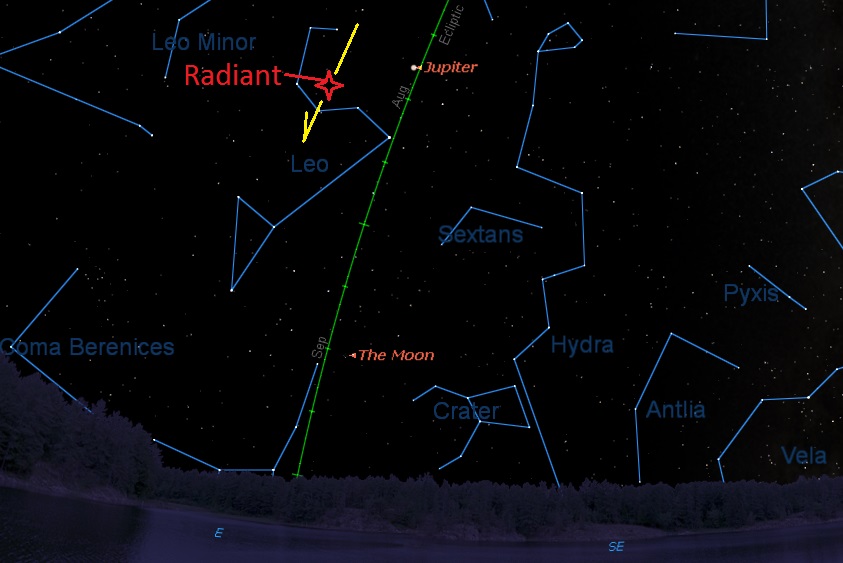
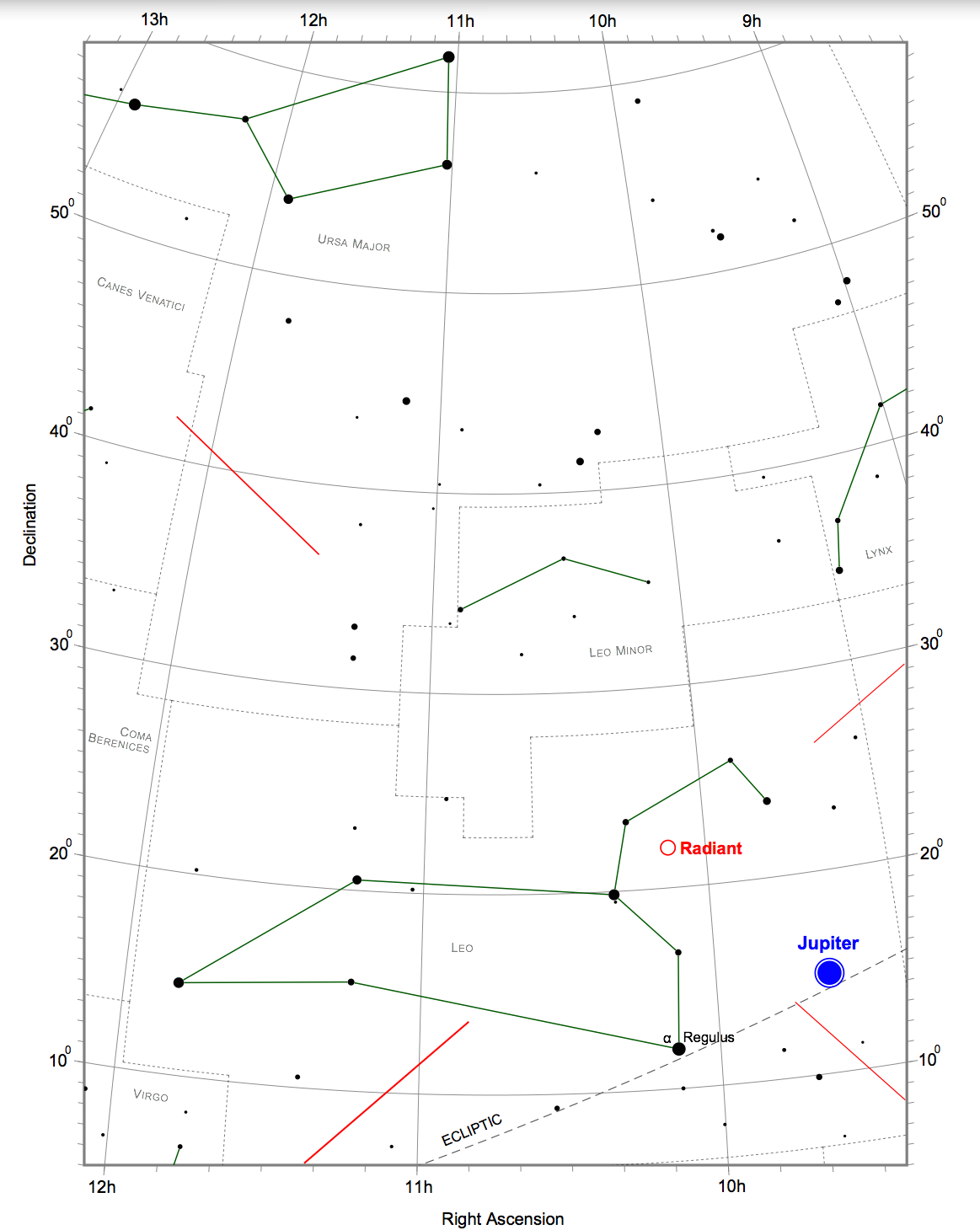
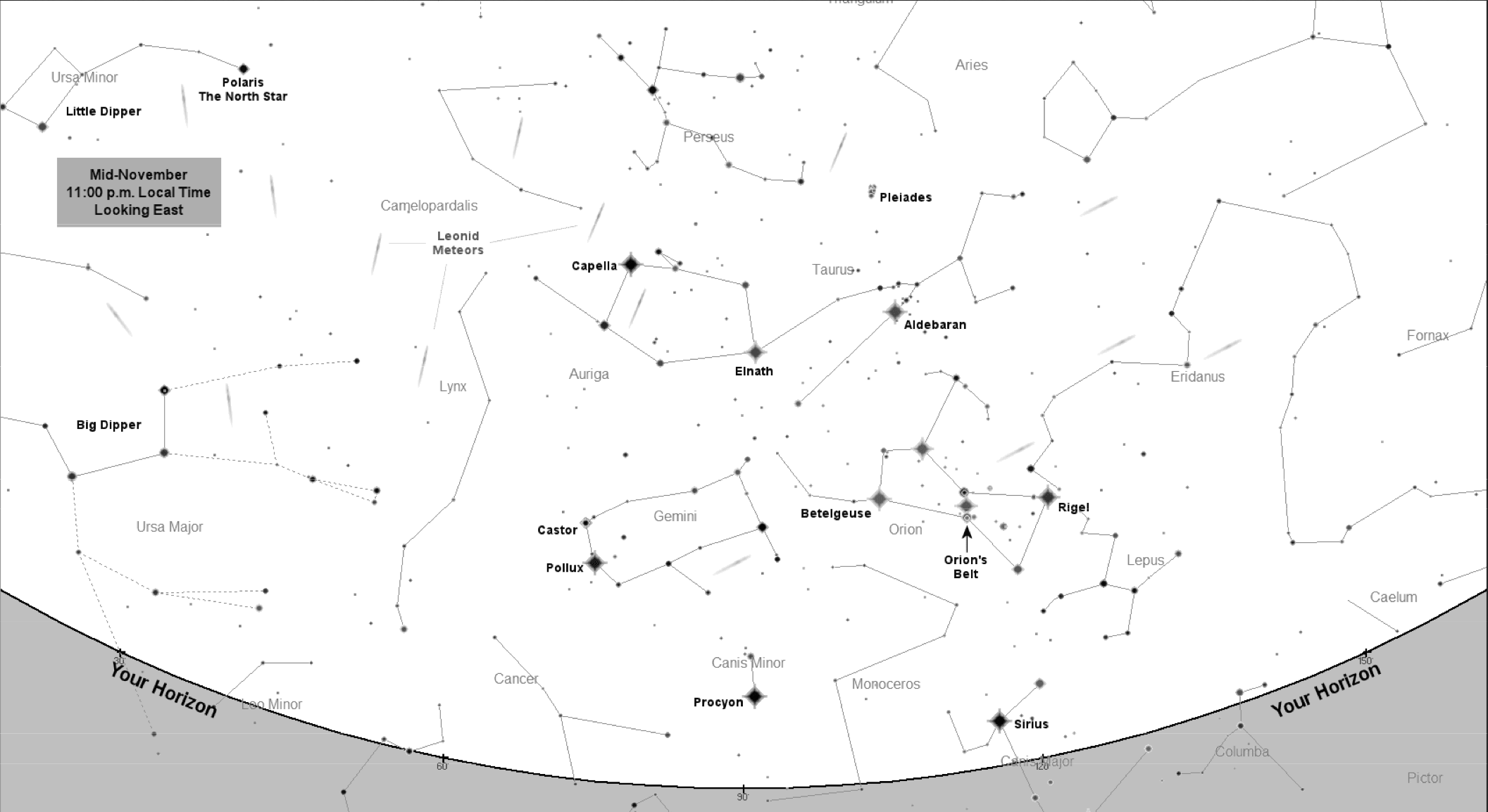
The Leonids are a prolific meteor shower associated with the comet Tempel-Tuttle. The Leonids get their name from the location of their radiant in the constellation Leo: the meteors appear to radiate from that point in the sky. (Credit: Wiki)
The November path of the radiant of the 2014 Leonids. Credit: Starry Night Education Software.
The Leonid meteor shower is forecasted to peak Monday afternoon (Nov. 17) in the U.S. eastern time zone, so stargazers in the United States are advised to look to the skies between midnight and dawn on Monday and Tuesday morning for the best view, astronomers say. This year, the Leonid meteor shower should treat skywatchers to beween 10 and 15 meteors per hour, NASA meteor expert Bill Cook, head of the Meteoroid Environment Office at the agency’s Marshall Space Flight Center in Huntsville, Alabama, told Space.com. For some meteor showers, that’s considered a decent rate.
NASA’s live stream will include a sky view from a telescope at Marshall Space Flight Center in Alabama. That stream will begin on Monday, Nov. 17 at 7:30 p.m. EST (0030 GMT Tuesday) and will continue until sunrise on Tuesday Nov. 18.
A meteor during the peak of the 2009 Leonid Meteor Shower. The photograph shows the meteor, afterglow, and wake as distinct components.(Credit: Wiki)
The Slooh live stream will begin on Monday, Nov. 17 at 8:00 p.m. EST (0100 GMT Tuesday) and will include more than just shots of the sky: Slooh will also broadcast audio of the “ionization sounds” created by the meteors. As the meteors streak through the sky, they briefly ionize the atmosphere. For a few seconds, the ionized region reflects short-wavelength radio waves, creating short blips and beeps of sound. Slooh’s broadcast will also include interviews with astronomers. (Credit: Calla Cofield and Spacce.com)
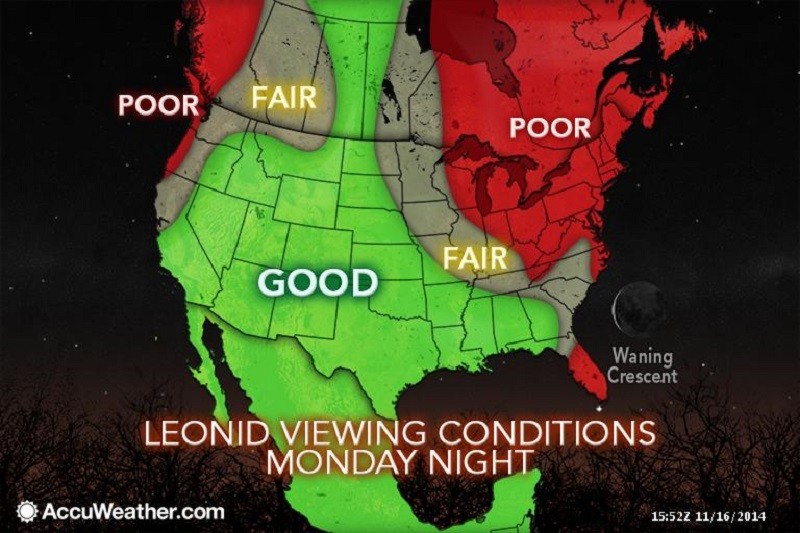
The waning-crescent moon will increase chances of a better view of the spectacle, according to NASA. This type of moon will create skies that are dark enough to view the meteors, which are characteristically bright and colorful.
“Widespread cloud cover across the eastern third of the U.S. will make it difficult to see the meteor shower Monday before dawn, except perhaps in central and south Florida. Skies should be much clearer Tuesday morning, though it may take until late at night for New England to clear out, and there will be clouds in south Florida and in the lake-effect snow belts of the Great Lakes. Clear skies will be the rule across the central and western U.S. both mornings, with only a few minor exceptions,” said Digital Meteorologist, Nick Wiltgen, from weather.com. (Credit: Carolyn Williams, weather.com)
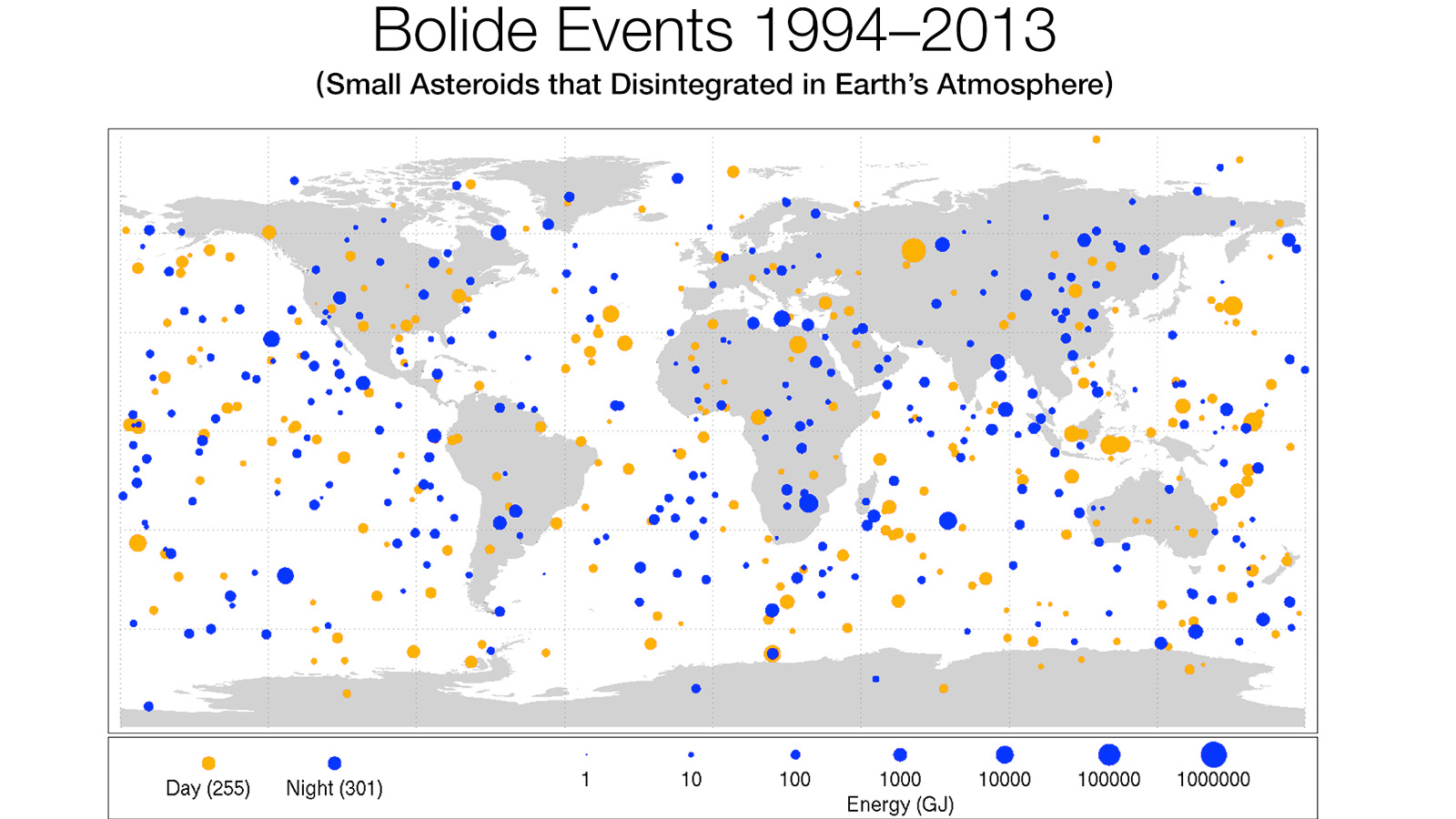
This diagram maps the data gathered from 1994-2013 on small asteroids impacting Earth’s atmosphere to create very bright meteors, technically called “bolides” and commonly referred to as “fireballs”. Sizes of red dots (daytime impacts) and blue dots (nighttime impacts) are proportional to the optical radiated energy of impacts measured in billions of Joules (GJ) of energy, and show the location of impacts from objects about 1 meter (3 feet) to almost 20 meters (60 feet) in size. Image (Credit: Planetary Science)
via scientificamerican
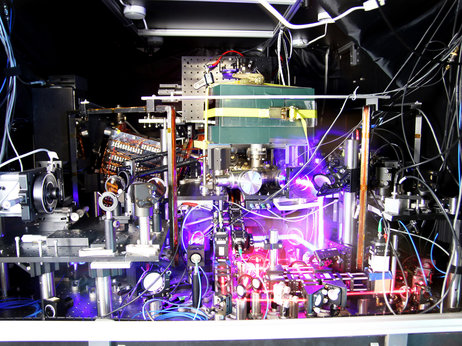
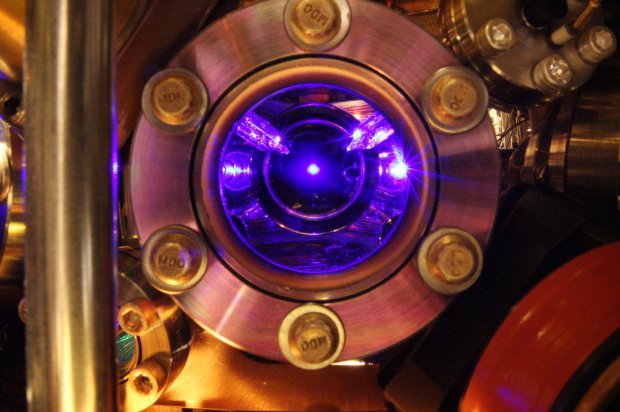
The world’s most precise atomic clock is a mess to look at. But it can tick for billions of years without losing a second. (Credit: Ye group and Baxley/JILA/Flickr)
Maybe its because we don’t understand time, that we keep trying to measure it more accurately. But that desire to pin down the elusive ticking of the clock may soon be the undoing of time as we know it: The next generation of clocks will not tell time in a way that most people understand. The new clock will keep perfect time for 5 billion years.
Strontium atoms floating in the center of this photo are the heart of the world’s most precise clock. The clock is so exact that it can detect tiny shifts in the flow of time itself. (Credit: Ye group, Brad Baxley/JILA)
“My own personal opinion is that time is a human construct,” says Tom O’Brian. O’Brian has thought a lot about this over the years. He is America’s official timekeeper at the National Institute of Standards and Technology in Boulder, Colorado.
To him, days, hours, minutes and seconds are a way for humanity to “put some order in this very fascinating and complex universe around us.”
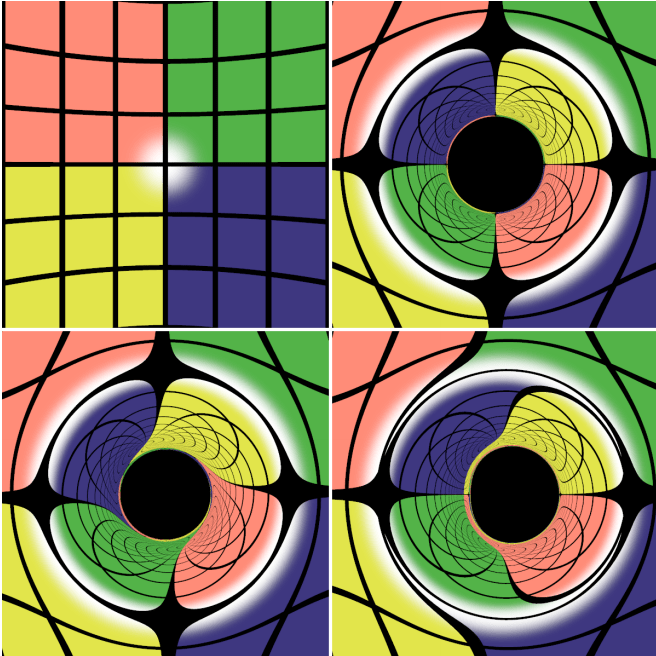
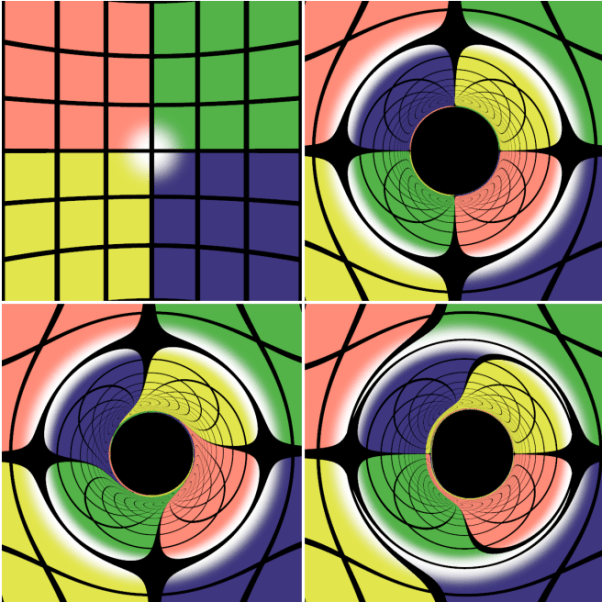
Lensing caused by various analytic spacetimes. For all panels, we use Figure 3 as a background, oriented such that the camera is pointed at the white reference dot. The camera has a 60 degree feld of view and is at a distance of 15 Schwarzschild radii from the origin measured using Kerr- Schild coordinates. The top row shows Minkowski and Schwarzschild spacetimes. The bottom row shows two views of the Kerr spacetime, with dimensionless spin x = 0.95, viewed with the camera pointing parallel to the spin axis of the black hole (bottom left) and perpendicular to the spin axis (bottom right). (Credit: A. Bohn, F. Hebert, W. Throwe, D. Bunadar, K. Henriksson, M. Scheel, N. Taylor)
The difficult part of this work is calculating the trajectory of the photons using the physics of general relativity. These equations are notoriously non-linear, so physicist sometimes simplify them by assuming that a system remains constant in the time it takes for light to pass by. The difficulty with black hole binaries is that this assumption does not hold— these objects orbit so rapidly as they approach each other that space-time warps, even during the time it takes for light to pass by.
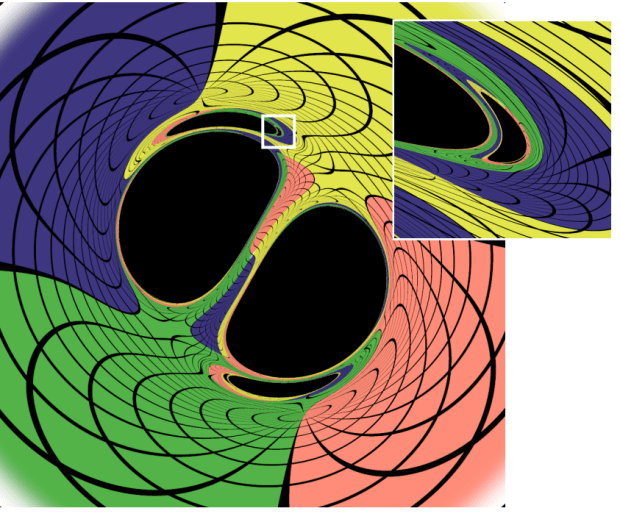
A BBH system of equal-mass black holes with no spin, viewed near merger with the orbital angular momentum out of the page. (Credit: A. Bohn, F. Hebert, W. Throwe, D. Bunadar, K. Henriksson, M. Scheel, N. Taylor)
Andy Bohn(et al.) at Cornell University in Ithaca, New York, reveals how in-spiraling black hole pairs should distort the light field around them. The team has concluded that from large distances, binaries are more or less indistinguishable from single black holes. Only a relatively close observer would be able to see the fascinating detail that they have simulating or one with very high resolving power.
The first observation of much bigger deflections, such as those produced by black holes or black hole pairs, will be something of a triumph for whoever spots them first.
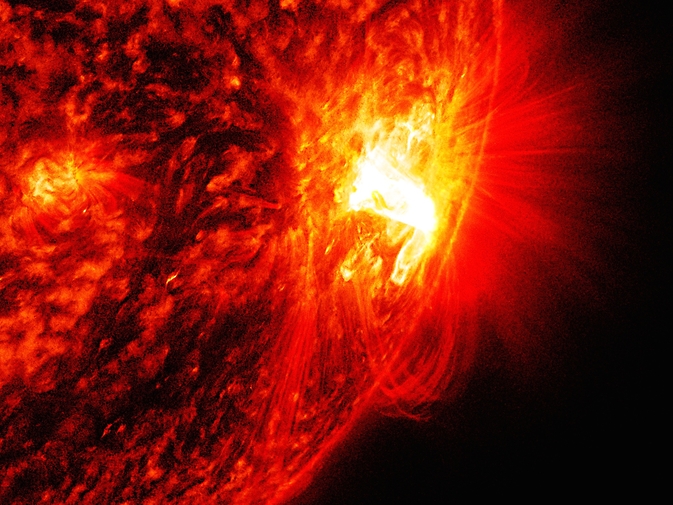
SDO captured a splendid example of expanding coronal loops seen in profile at the edge of the Sun (Oct. 14-15, 2014). The bright loops began to form and grow after a long-lasting M-class flare erupted. The arcs of the loops we see in extreme ultraviolet light are actually particles spiraling along magnetic field lines arcing above the active region that was the source of the flare. They are reorganizing the magnetic field after its disruption. To give a sense of scale, these huge loops are reaching out more than 15 times the size of Earth.