Dark matter interacts with itself and everything else even less than previously thought

Astronomers have found that dark matter does not slow down when colliding with each other.
hs-2015-10-a-web_print
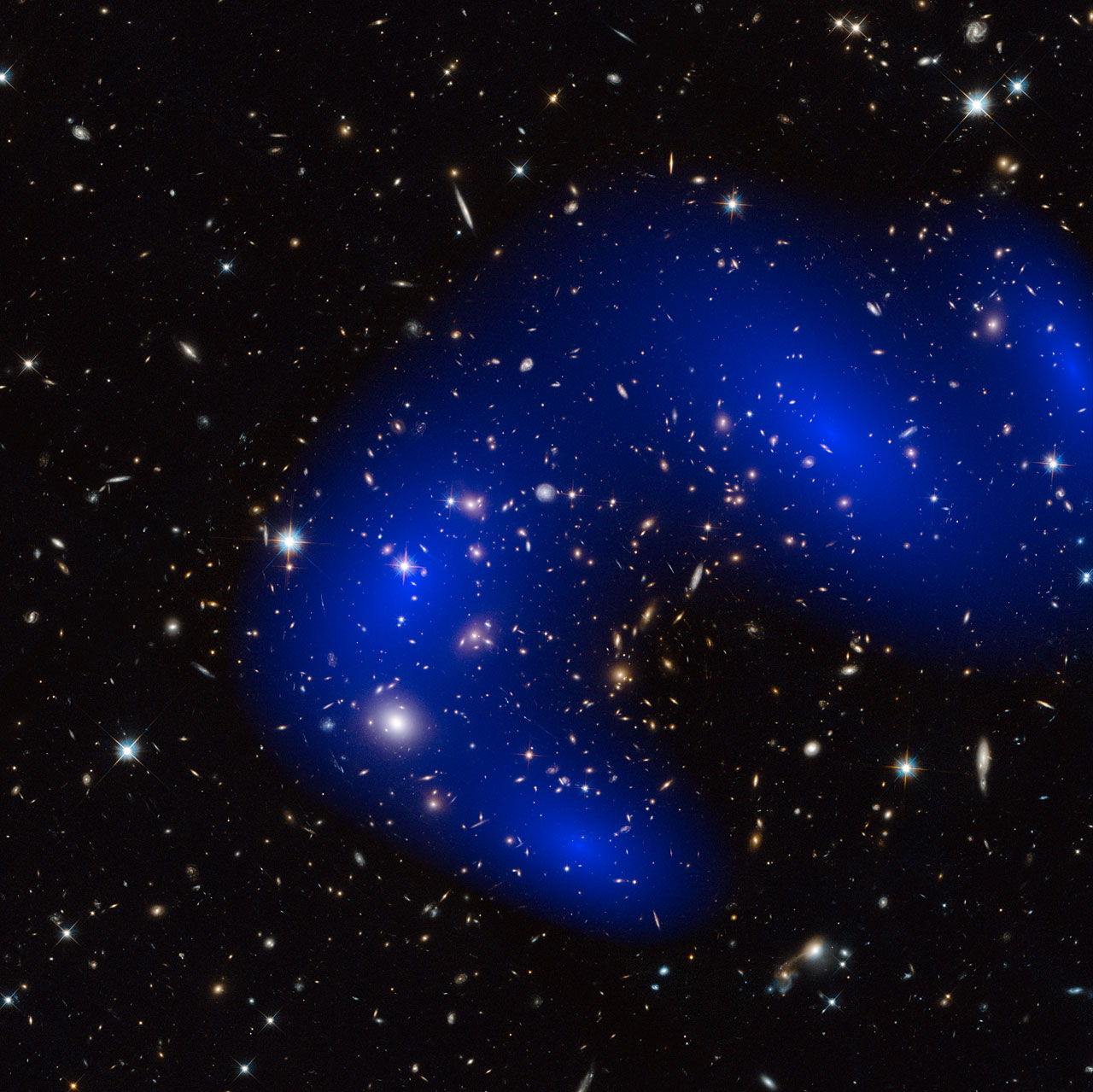
Using visible-light images from Hubble, the team was able to map the post-collision distribution of stars and also of the dark matter (colored in blue), which was traced through its gravitational lensing effects on background light. Chandra was used to see the X-ray emission from impacted gas (pink).(Credit: NASA, ESA, STScI, and CXC)

Researchers say this finding narrows down the options for what this mysterious substance might be.  Because dark matter does not reflect, absorb, or emit light, it can only be traced indirectly, such as by measuring how it warps space through gravitational lensing.
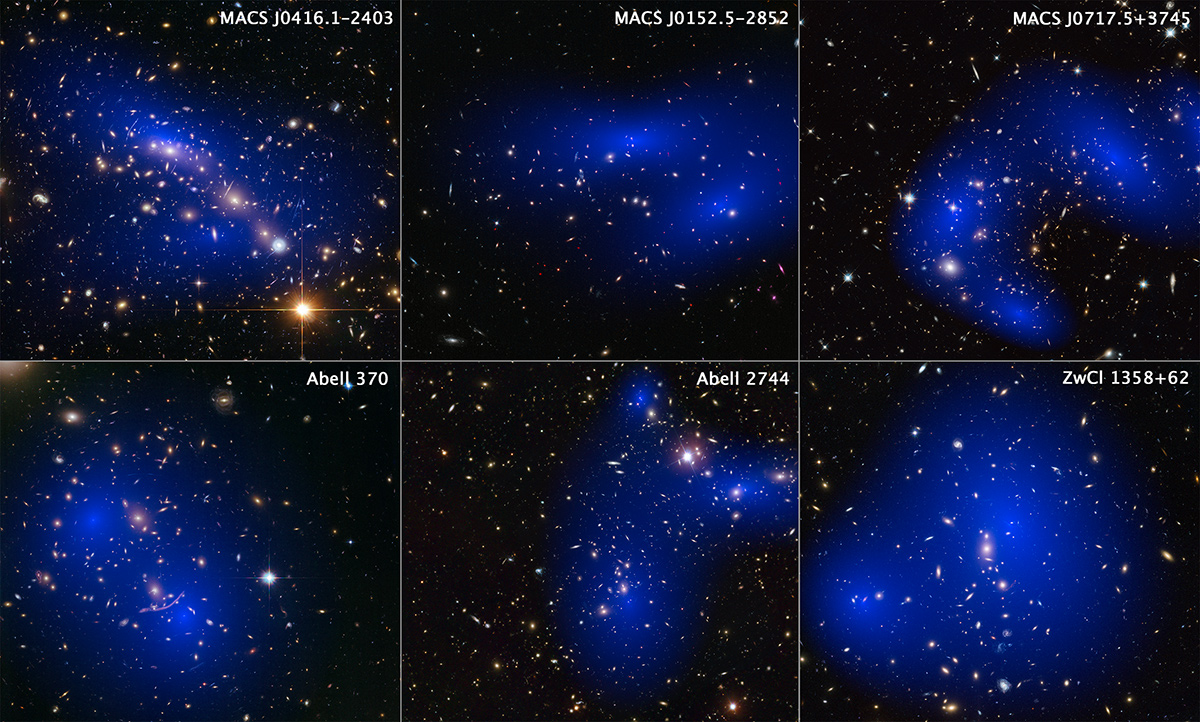
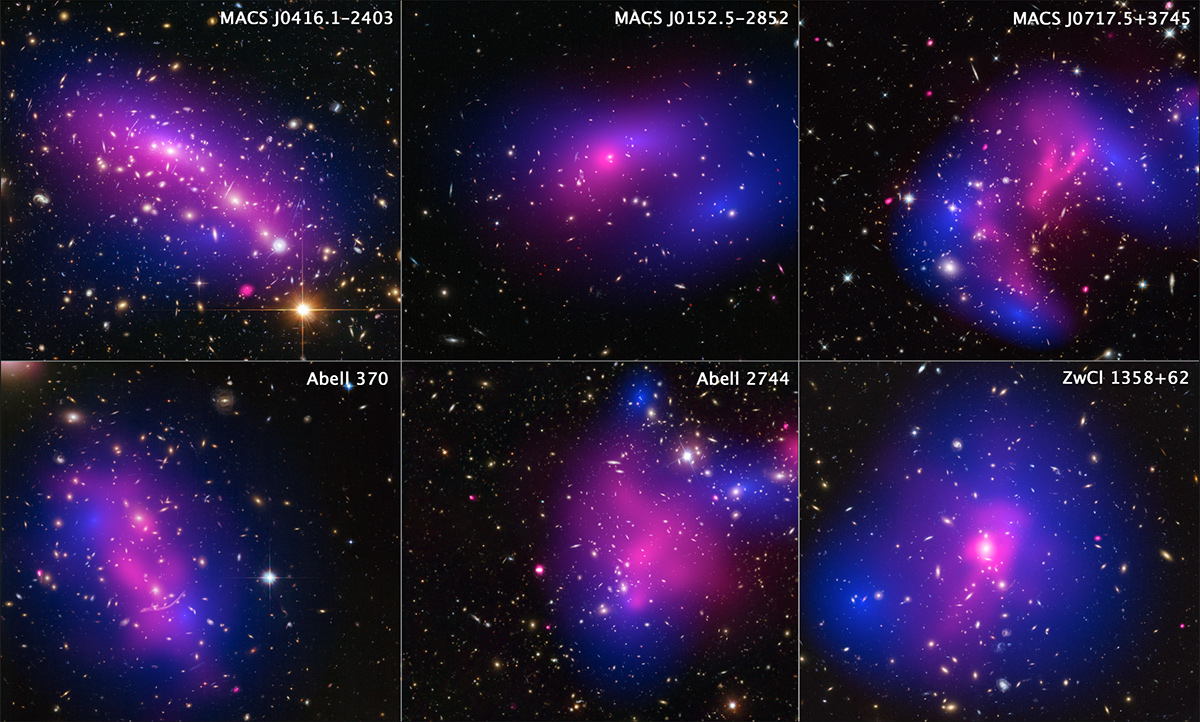
This collage shows images of six different galaxy clusters taken with NASA's Hubble Space Telescope. The clusters were observed in a study of how dark matter in clusters of galaxies behaves when the clusters collide. Seventy-two large cluster collisions were studied in total. Using visible-light images from Hubble, the team was able to map the post-collision distribution of stars and also of the dark matter (colored in blue), which was traced through its gravitational lensing effects on background light. The team determined that dark matter interacts with itself less than previously thought. The clusters shown here are, from left to right and top to bottom: MACS J0416.1-2403, MACS J0152.5-2852, MACS J0717.5+3745, Abell 370, Abell 2744, and ZwCl 1358+62. Image Type: Astronomical/Annotated Credit: NASA, ESA, D. Harvey (École Polytechnique Fédérale de Lausanne, Switzerland; University of Edinburgh, UK), R. Massey (Durham University, UK), T. Kitching (University College London, UK), and A. Taylor and E. Tittley (University of Edinburgh, UK)
This collage shows images of six different galaxy clusters taken with NASA’s Hubble Space Telescope. The clusters were observed in a study of how dark matter in clusters of galaxies behaves when the clusters collide. Seventy-two large cluster collisions were studied in total. (Credit: NASA, ESA, D. Harvey (École Polytechnique Fédérale de Lausanne, Switzerland; R. Massey, T. Kitching, and A. Taylor and E. Tittley.)

NASA’s Hubble Space Telescope and Chandra X-ray Observatory were used to study how dark matter in clusters of galaxies behaves when the clusters collide. Hubble was used to map the post-collision distribution of stars and dark matter, which was traced through its gravitational lensing effects on background light. Chandra was used to see the X-ray emission from the colliding gas. The results will be published in the journal Science on March 27.

“Dark matter is an enigma we have long sought to unravel,” said John Grunsfeld, assistant administrator of NASA’s Science Mission Directorate in Washington. “With the combined capabilities of these great observatories, both in extended mission, we are ever closer to understanding this cosmic phenomenon.”
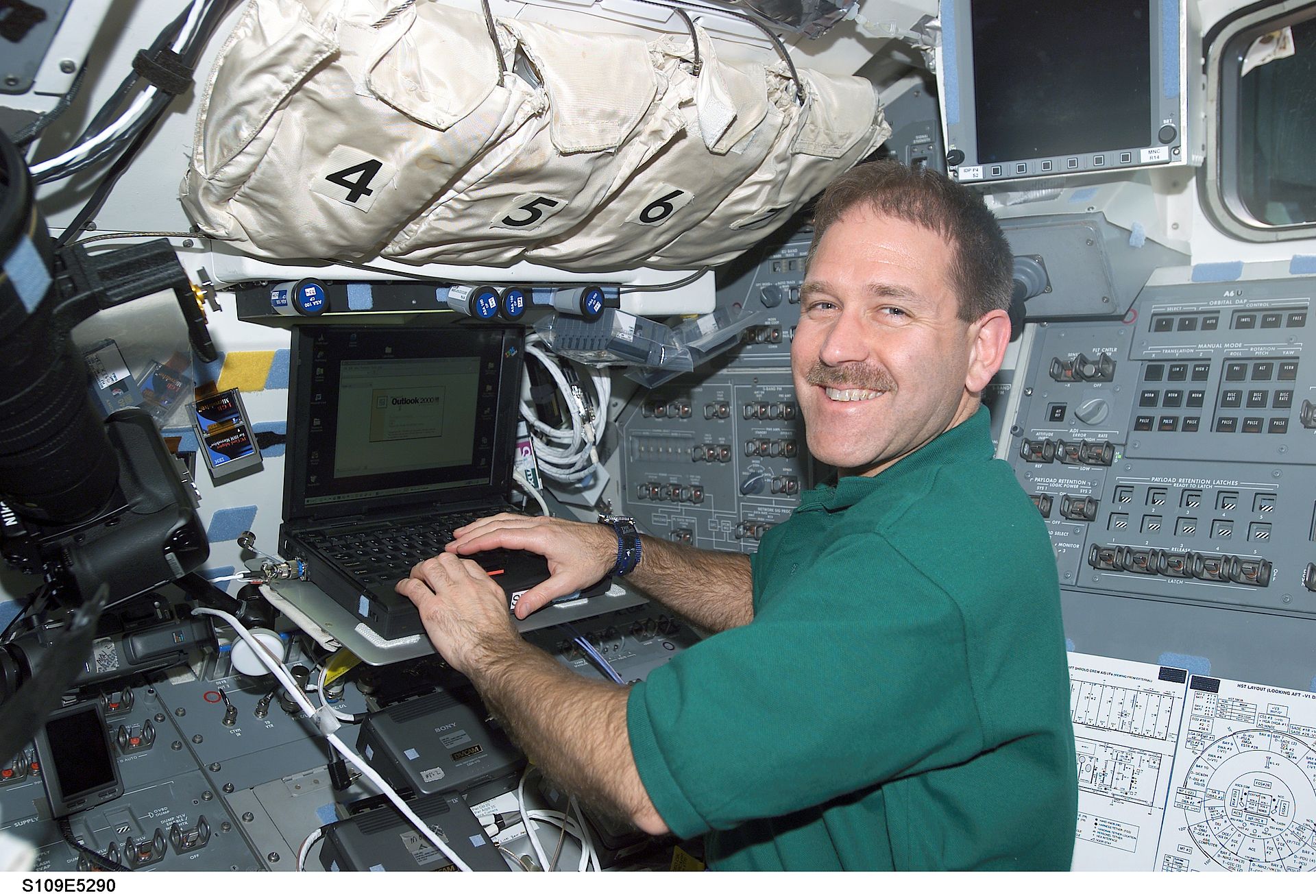
John Grunsfeld, assistant administrator of NASA’s Science Mission Directorate in Washington.
John Grunsfeld, assistant administrator of NASA’s Science Mission Directorate in Washington, during STS-109 March 4, 2002.(Credit: NASA)

To learn more about dark matter, researchers can study it in a way similar to experiments on visible matter — by watching what happens when it bumps into celestial objects. An excellent natural laboratory for this analysis can be found in collisions between galaxy clusters.

Galaxy clusters are made of three main ingredients: galaxies, clouds of gas, and dark matter. During collisions, the clouds of gas enveloping the galaxies crash into each other and slow down or stop. The galaxies are much less affected by the drag from the gas and, because of the huge gaps between the stars within them, do not have a slowing effect on each other.

“We know how gas and galaxies react to these cosmic crashes and where they emerge from the wreckage. Comparing how dark matter behaves can help us to narrow down what it actually is,” explained David Harvey of the École Polytechnique Fédérale de Lausanne, Switzerland, lead author of the new study.

Harvey and his team used data from Hubble and Chandra to study 72 large cluster collisions. The collisions happened at different times, and are seen from different angles — some from the side, and others head-on.

The team found that, like the galaxies, the dark matter continued straight through the violent collisions without slowing down relative to the galaxies. Because galaxies pass through unimpeded, if astronomers observe a separation between the distribution of the galaxies and the dark matter then they know it has slowed down. If the dark matter does slow, it will drag and lie somewhere between the galaxies and the gas, which tells researchers how much it has interacted.

The leading theory is that dark matter particles spread throughout the galaxy clusters do not frequently bump into each other. The reason the dark matter doesn’t slow down is because not only does it not interact with visible particles, it also infrequently interacts with other dark matter. The team has measured this “self-interaction” and found it occurs even less frequently than previously thought.

“A previous study had seen similar behavior in the Bullet Cluster,” said team member Richard Massey of Durham University, U.K. “But it’s difficult to interpret what you’re seeing if you have just one example. Each collision takes hundreds of millions of years, so in a human lifetime we only get to see one freeze-frame from a single camera angle. Now that we have studied so many more collisions, we can start to piece together the full movie and better understand what is going on.”
This is a NASA/ESA Hubble Space Telescope image of the galaxy cluster Abell 370. Shown in blue on the image is a map of the dark matter found within the cluster. (Credit NASA, ESA)

“It is unclear how much we expect dark matter to interact with itself because dark matter is already going against everything we know, said Harvey. “We know from previous observations that it must interact with itself reasonably weakly, however this study has now placed it below that of two protons interacting with one another — which is one theory for dark matter.” Harvey said that the results suggest that dark matter is unlikely to be only a kind of dark proton. If dark matter scattered like protons do with one another (electrostatically) it would have been detected. “This challenges the idea that there exists ‘dark photons,’ the dark matter equivalent of photons,” he said.

Dark matter could potentially have rich and complex properties, and there are still several other types of interactions to study. These latest results rule out interactions that create a strong frictional force, causing dark matter to slow down during collisions. Other possible interactions could make dark matter particles bounce off each other like billiard balls, causing dark matter particles to be ejected from the clouds by collisions or for dark matter blobs to change shape. The team will be studying these next.

To further increase the number of collisions that can be studied, the team is also looking to study collisions involving individual galaxies, which are much more common.

“There are still several viable candidates for dark matter, so the game is not over, but we are getting nearer to an answer,” concludes Harvey. “These ‘astronomically large’ particle colliders are finally letting us glimpse the dark world all around us but just out of reach.”

Credit: Hubblesite.org

The spin limit of colliding black holes

Adam Day's avatarCQG+

Geoffrey LovelaceGeoffrey Lovelace is an Assistant Professor of Physics at California State University, Fullerton. As member of Fullerton’s Gravitational-Wave Physics and Astronomy Center and the Simulating eXtreme Spacetimes collaboration, his research interests focus on using computer simulations to model colliding black holes and neutron stars and the gravitational waves they emit.

A single black hole’s size limits its spin. Do colliding black holes obey this limit?

In our recent paper, published in Classical and Quantum Gravity, we take a first look at how supercomputer simulations can help reveal the answer.

A black hole is an object whose gravity is so strong that nothing, even light, can escape from inside its horizon. An isolated, uncharged black hole can be completely described by just two numbers: its spin and its horizon surface area. All of the black hole’s properties then follow from Kerr’s solution of Einstein’s equations.

Kerr’s solution implies…

View original post 497 more words

How Do We Know When We Have Collected a Sample of Bennu?

dslauretta's avatardslauretta

Guest Blogger: Kevin Walsh

A huge amount of effort goes into deciding where to try to collect a sample on Bennu. There are roughly nine months to survey, map and model the asteroid to help make this decision, and I will describe some of the important factors of that decision below.

Just as important – after our first attempt to collect a sample – is the decision whether or not to stow the sample and return home, or stay at Bennu and try to collect more (or some) material. This decision needs to be made in 10 days. These are vastly different timescales – nine months versus 10 days, but both are important to the success of the mission.

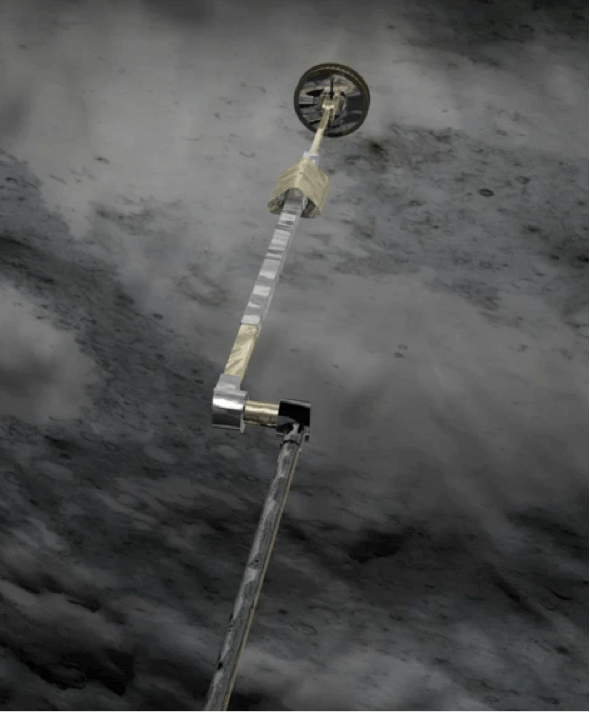
Figure 1: Artist view looking from the spacecraft down at the extended arm, and the sampling device during the descent to the surface. Figure 1: Artist view looking from the spacecraft down at the extended arm, and the sampling device during the descent to the surface.

Sampleability

The OSIRIS-REx mission will spend nearly nine…

View original post 1,479 more words

UA Science Lecture Series: Life in the Universe.

redacted's avatarBob R Bogle

Tonight the 10th anniversary of the UA Science Lecture Series came to its conclusion. This year’s lecture series was entitled “Life in the Universe.” You can read summaries of each lecture here. If you’re interested in the preceding nine Lecture Series, you can learn about them here.

Lecture 1: What is Life?

Lecture 2: Planet Formation and the Origin of Life.

Lecture 3: Life on Earth: by Chance or by Law?

Lecture 4: Complexity and Evolvability: What Makes Life so Interesting?

Lecture 5: Searching for Life in the Solar System.

Lecture 6: Amazing Discoveries: A Billion Earth-Like Worlds.

Lecture 7: Intelligent Life Beyond Earth.

View original post

Rapid Changes in Lovejoy Comet’s Tail Observed

A team of astronomy researchers from Stony Brook University, the National Astronomical Observatory of Japan, and Tsuru University are the first to reveal clear details about the rapidly changing plasma tail of the comet C/2013 R1 (Lovejoy). The observation and details behind the discovery are published in a paper in the March 2015 edition of the Astronomical Journal.

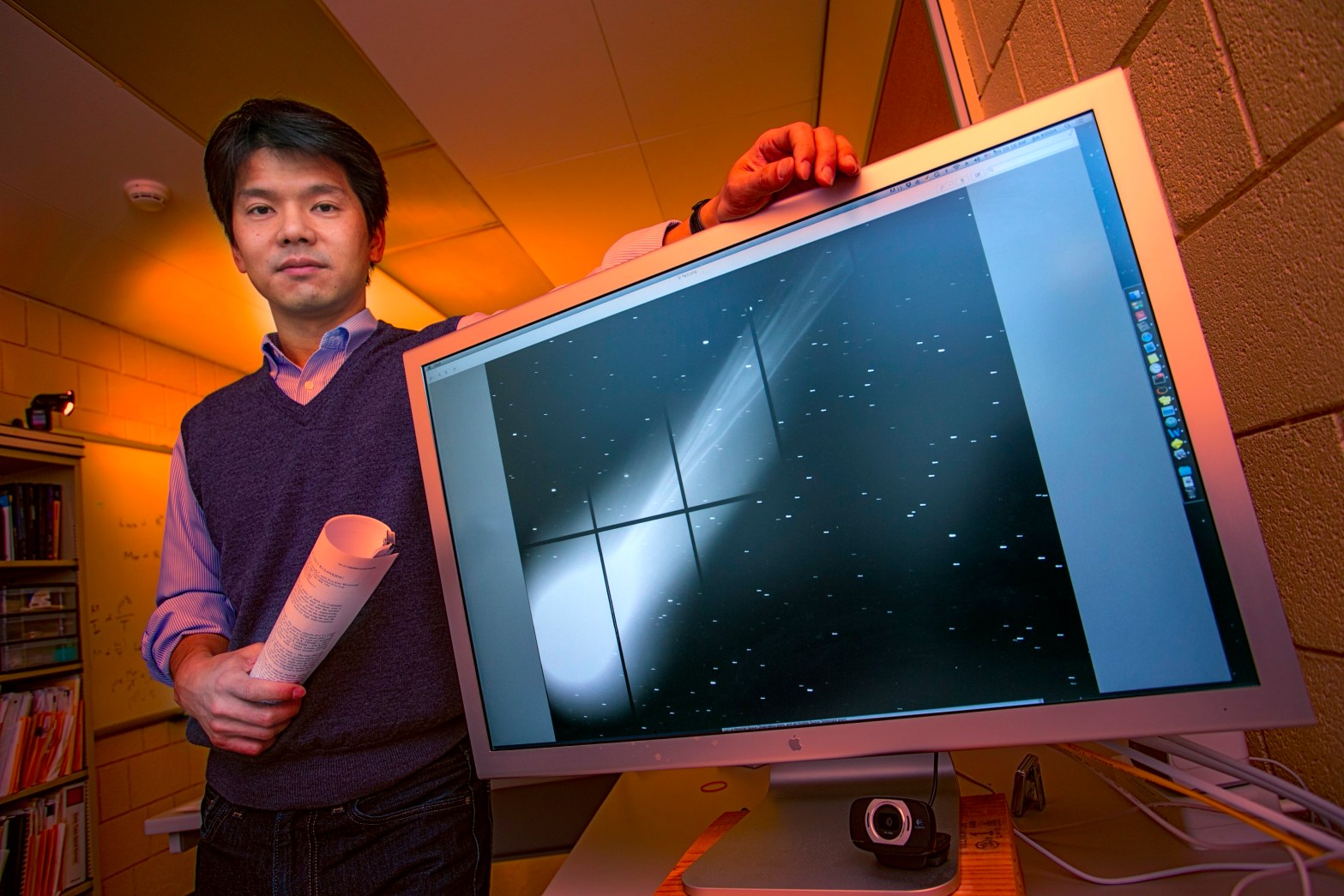
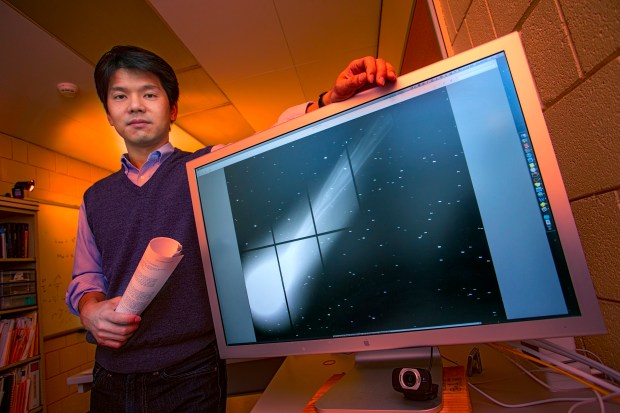
Stony Brook University’s Jin Koda alongside an image of the rapidly changing plasma tail of the comet C/2013 R1 (Lovejoy).
Stony Brook University’s Jin Koda alongside an image of the rapidly changing plasma tail of the comet C/2013 R1 (Lovejoy). (Credit: Stony Brook University)

The team, Led by Jin Koda, PhD, Assistant Professor in the Department of Physics and Astronomy at Stony Brook University, captured the images by using the Subaru Telescope’s wide-field prime-focus camera, called Suprime-Cam, which resulted in gaining new knowledge regarding the extreme activity in that tail as the comet neared the Sun.

“My research is on galaxies and cosmology, but I always want to explore beyond these boundaries. Lovejoy was up in the sky after my targets were gone, and we started taking other images for educational and outreach purposes, and for curiosity,” said Dr. Koda. “The single image from one night revealed such delicate details along the tail that it inspired us further to take a series of images on the following night. When we analyzed these additional images, we realized that the tail was displaying rapid motion in a matter of only a few minutes. This was an incredible discovery.”

In their paper, “Initial Speed of Knots in the Plasma Tail of C/213 R1 (Lovejoy),” the researchers report short-time variations in the plasma tail of Lovejoy.

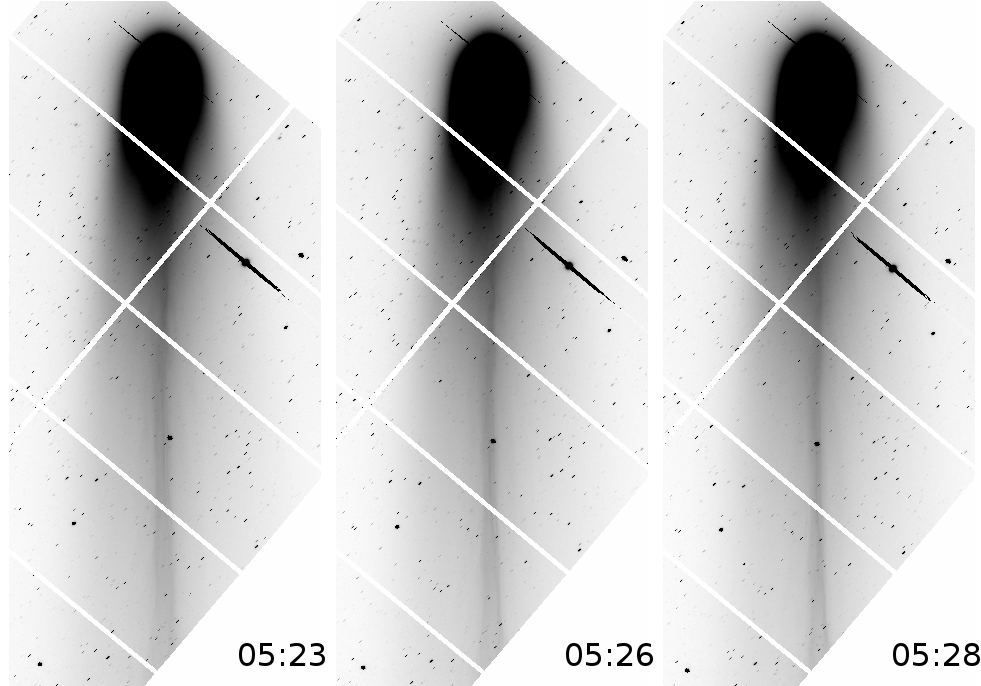
This GIF animation shows changes in the global structure of Comet Lovejoy’s (C/2013 R1) plasma tail. The time stamp at the bottom right shows the start time of each of three 2-minute exposure in Hawaii time on the morning of 12/4/13. In these I-band images, the tail narrows with time, especially downstream of the nucleus (at the bottom of the image). Moreover, two clumps were detected formed at about 0.3 million kilometers from the nucleus. Note: The image is aligned so that the nucleus of the comet is at the same position and the tail lies vertically. Bright parts of the sky are shown as black, and dark parts are shown as white, allowing astronomers to see details in the object more clearly. The white tilted grid is a gap between CCD detectors. Credit: National Astronomical Observatory of Japan. Images processed by M. Yagi. Credit: the National Astronomical Observatory of Japan. Images processed by M. Yagi
Changes in the global structure of Comet Lovejoy’s (C/2013 R1) plasma tail. The time stamp at the bottom right shows the start time of each of three 2-minute exposure in Hawaii time on the morning of 12/4/13. In these I-band images, the tail narrows with time, especially downstream of the nucleus (at the bottom of the image). Two clumps were detected formed at about 0.3 million kilometers from the nucleus. Note: The image is aligned so that the nucleus of the comet is at the same position and the tail lies vertically. Bright parts of the sky are shown as black, and dark parts are shown as white, allowing astronomers to see details in the object more clearly. The white tilted grid is a gap between CCD detectors. (Credit: NAO of Japan, M. Yagi)

They suggest that “these rapid motions suggest the need for high time-resolution studies of comet plasma tails with a large telescope,” and that, “A series of short (2-3 minutes) exposure images with the 8.2 m Subaru telescope shows faint details of filaments and their motions over a 24 minutes observing duration. We identified rapid movements of two knots in the plasma tail near the nucleus. Their speeds are 20 and 25 kms along the tail and 2.8 and 2.2 kms across it respectively. These set a constraint on an acceleration model of plasma tail and knots as they set the initial speed just after their formation. We also found a rapid narrowing of the tail.”

Dr. Koda explained that the plasma tail of a comet forms when gas molecules and atoms coming out from the comet encounter the solar wind. Changes and disturbances in the solar wind can affect the behavior and appearance of this plasma tail, causing it to form clumps of ionized material. The material in the plasma tail departed from the comet’s coma and floats away on the solar wind. At these times, the plasma tail can take on a “kinked” or twisted look.

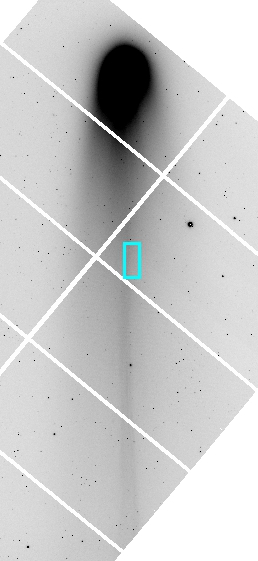
A 2-second I-band exposure of the comet. The cyan rectangle shows the region in the right panel. Credit: the National Astronomical Observatory of Japan. Images processed by M. Yagi.
A 2-second I-band exposure of the comet. The cyan rectangle shows the region in the right panel. Credit: the National Astronomical Observatory of Japan. (Credit: M. Yagi)

In 2013, the team reported highly resolved fine details of this comet captured in B-band filter in Subaru Telescope’s Image Captures the Intricacy of Comet Lovejoy’s Tail. They used I-band filter which includes H2O+ line emissions and V-band filter which includes CO+ and H2O+ line emissions. During the observations, the comet exhibited very rapid changes in its tail in the course of only 20 minutes (Figure 1). Such extreme short-term changes are the result of the comet’s interactions with the solar wind where charged particles constantly sweeping out from the Sun. They explain that the reason for the rapidity of these changes is not well understood.

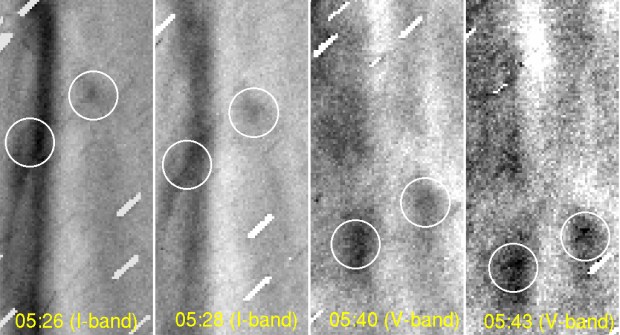
By using the Subaru Telescope, they also discovered that clumps located in the plasma tail at about 300 thousand kilometers from the nucleus moved fairly slow speed at about 20-25 kilometers per second (Figure 2). That is much slower than reported in other comets, such as P/Halley, which gave off clumps that moved as fast as 58 kilometers per second or the value 44 +/- 11 kilometers per second (Note 2) as derived from several bright comets in the past.

This shows movement of the two clumps in the plasma tail. Time stamps in yellow show the start time of the exposure. White circles indicate the clumps detected in the study. They move away from the nucleus over time. The size of the cutout is about 2500 X 5600 kilometers. The research team calculated the speed of the clumps at 20-25 kilometers per second. Note: Images produced from 2-minute exposures are further processed; background star trails are masked, and unsharp-masked to enhance detailed structures. The masked star trails are seen as short tilted white lines. Credit: the National Astronomical Observatory of Japan. Images processed by M. Yagi.
This shows movement of the two clumps in the plasma tail. Time stamps in yellow show the start time of the exposure. White circles indicate the clumps detected in the study. They move away from the nucleus over time. The size of the cutout is about 2500 X 5600 kilometers. The research team calculated the speed of the clumps at 20-25 kilometers per second. Note: Images produced from 2-minute exposures are further processed; background star trails are masked, and unsharp-masked to enhance detailed structures. The masked star trails are seen as short tilted white lines. (Credit: NAOof Japan,M. Yagi)

The speed of the solar wind ranges from 300 to 700 kilometers per second, and the intensity and velocity that the comet encounters depends on where it is located with respect to the Sun. The solar wind helps to accelerate the clumps in the tail out away from the Sun. Dr. Koda explained that eventually the clumps in the comet’s tail reach this high speed.

The observation team believes they witnessed the beginning of the acceleration of the clumps by the solar wind, however it is still under investigation how these ion clumps form and what parameters determine the initial speed of them.

The team concluded that because of the Subaru Telescope capacity for large photon collection coupled with the wide field-of-view camera they were able to and fortunate enough to catch the rare tail condition before it disappeared. Dr. Koda says their discovery is the first such demonstration underscoring the need for use of a large telescope to capture rapid motions of comets’ tails in action. They also conclude that with such a powerful instrument, more observations will help to contribute to the better understanding of comets. Such observations would include a series of images for longer periods of time, which would help the team learn more about how the comet tail moves and evolves.

Credit: Stonybrook.edu