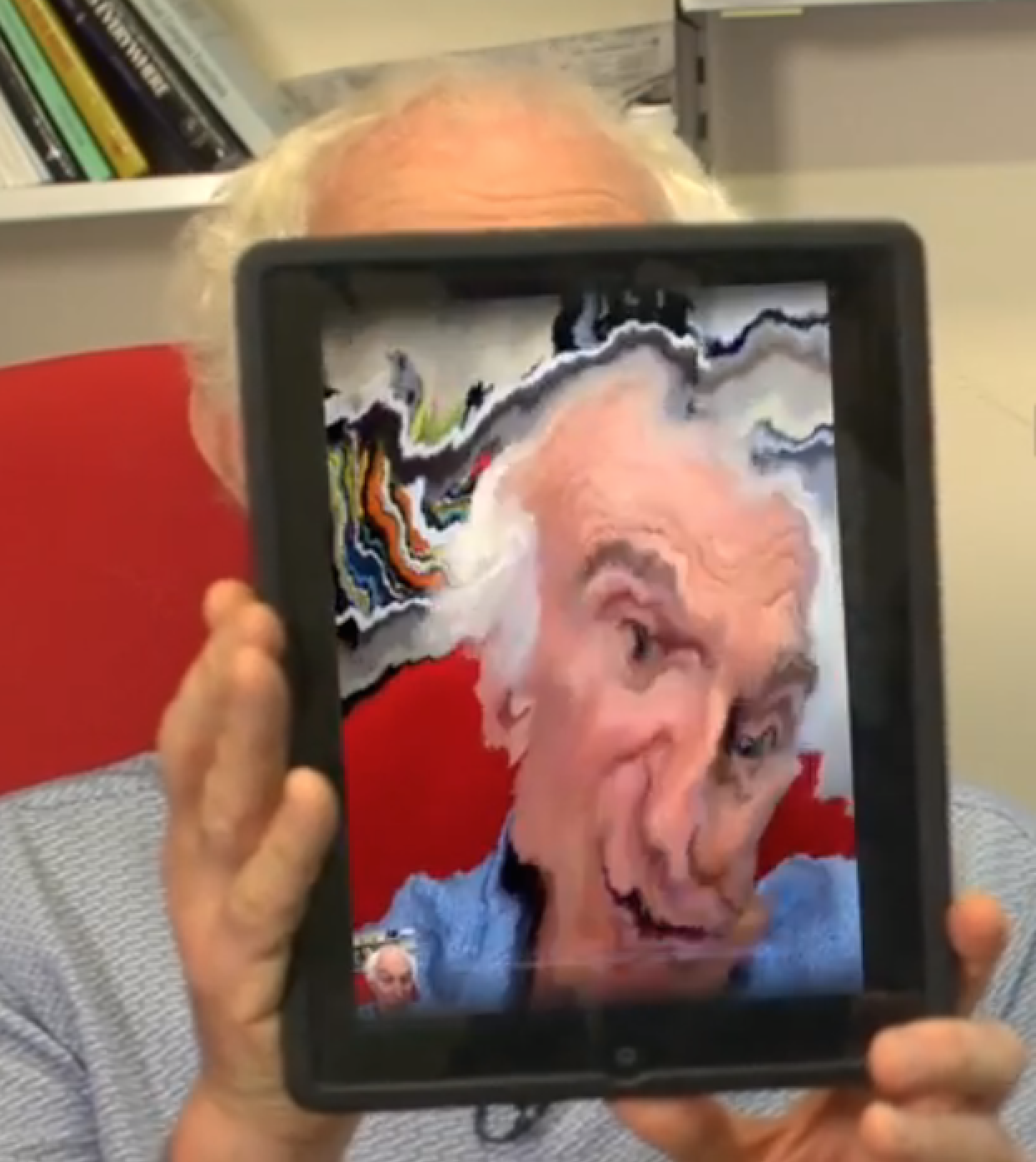
Professor Michael Barnsley with a fractally transformed teacup and pot. (Credit: Phil Dooley, ANU)
An ANU mathematician has developed a new way to uncover simple patterns that might underlie apparently complex systems, such as clouds, cracks in materials or the movement of the stockmarket.
“Fractal Geometry is a new branch of mathematics that describes the world as it is, rather than acting as though it’s made of straight lines and spheres. There are very few straight lines and circles in nature. The shapes you find in nature are rough.” said Michael Barnsley, Professor of Mathematics at ANU.
FrangoCamera App developed at ANU. (Credit ANU)
“Fractal Fourier analysis provides a method to break complicated signals up into a set of well understood building blocks, in a similar way to how conventional Fourier analysis breaks signals up into a set of smooth sine waves,” said Professor Michael Barnsley, who who presented his work at the New Directions in Fractal Geometry conference.
“There are terrific advances to be made by breaking loose from the thrall of continuity and differentiability…The body is full of repeating branch structures – the breathing system, the blood supply system, the arrangement of skin cells, even cancer is a fractal.”
SASTPC is thrilled to announce a collaboration with the University of Arizona’sPhilosophy Department. We will be posting more information as soon as it develops. Please stay tuned! Thank you for your support!
UPDATE 4/8/2015
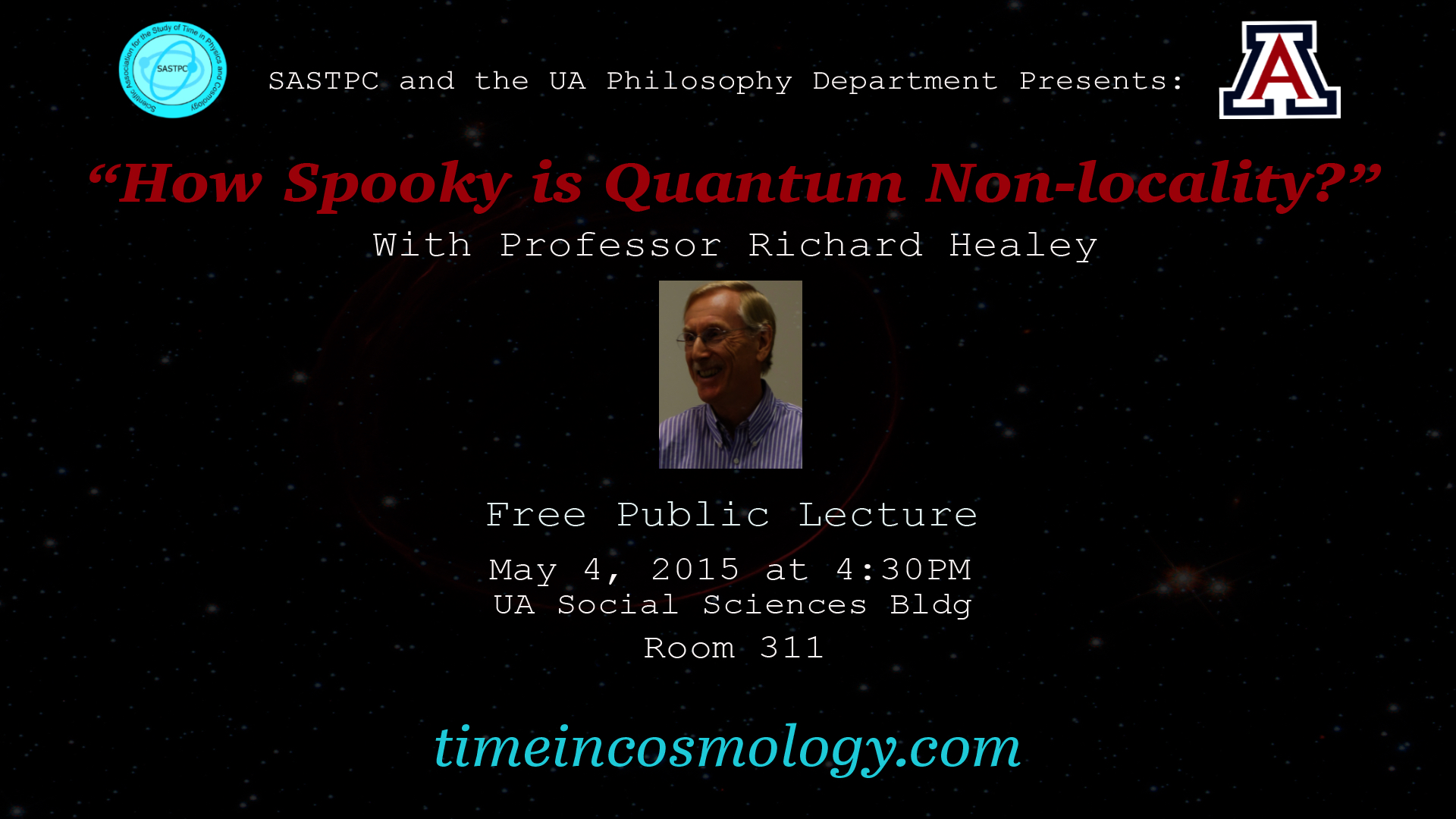
The Scientific Association for the Study of Time in Physics and Cosmology (SASTPC) in association with the University of Arizona Philosophy Department cordially invite you to attend our inaugural Time in Cosmology Speaker Series: “How spooky is quantum non-locality?” presented by Director of Graduate Studies, Philosophy Professor Richard Healey.
Date: May 4, 2015
Time: 4:30PM
Location: University of Arizona, Social Sciences Building, Room 311
Topic001 Discussion on Redshift Magnitude Bands, Bill Tifft 11/12/14
QTC really seriously began with the discovery of Redshift-Magnitude Bands
in the Coma cluster of galaxies. For light the redshift (or blueshift) is a
frequency shift seen in spectral features which can be caused several ways.
Interpreted as due to motion (a Doppler shift) it is conveniently expressed
as a velocity, V, or in dimensionless units z=V/c where c is the speed of
light. I will use both V and z for convenience only, leaving interpretation
of what really causes the shift open for discussion. The redshift is just an
observable quantity at this point of discussion, the ultimate issue here is what really is the cosmic redshift?
The magnitude of a galaxy is just a measure of how much energy is being
emitted into space, and how far away the galaxy is. There is little doubt about what magnitude means…
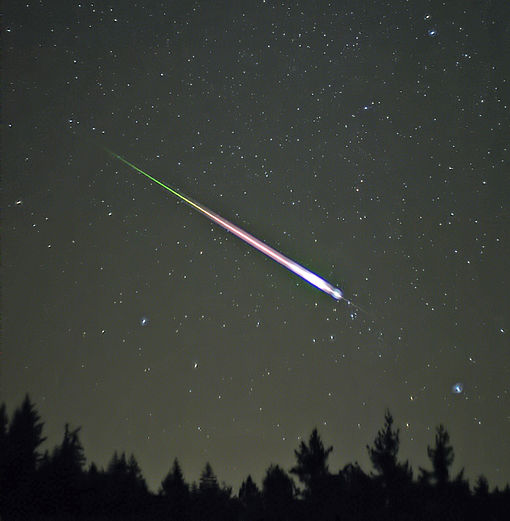
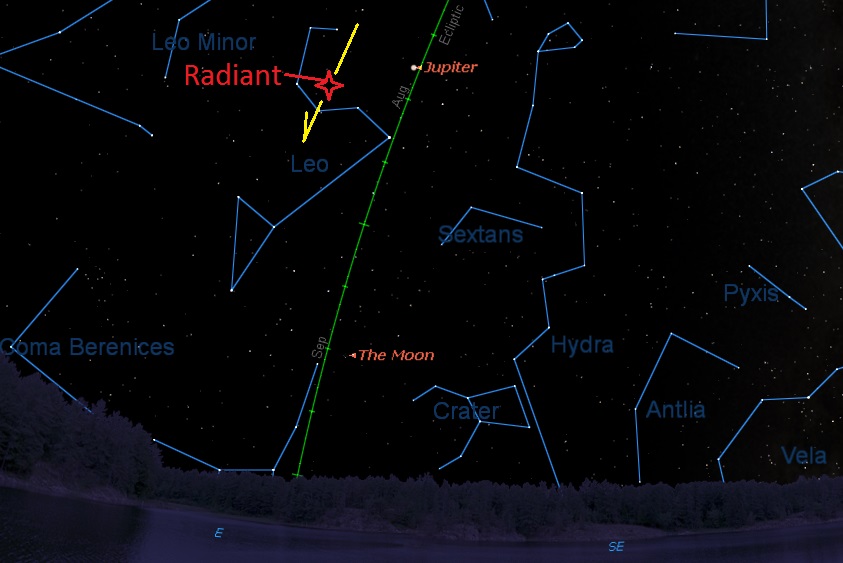
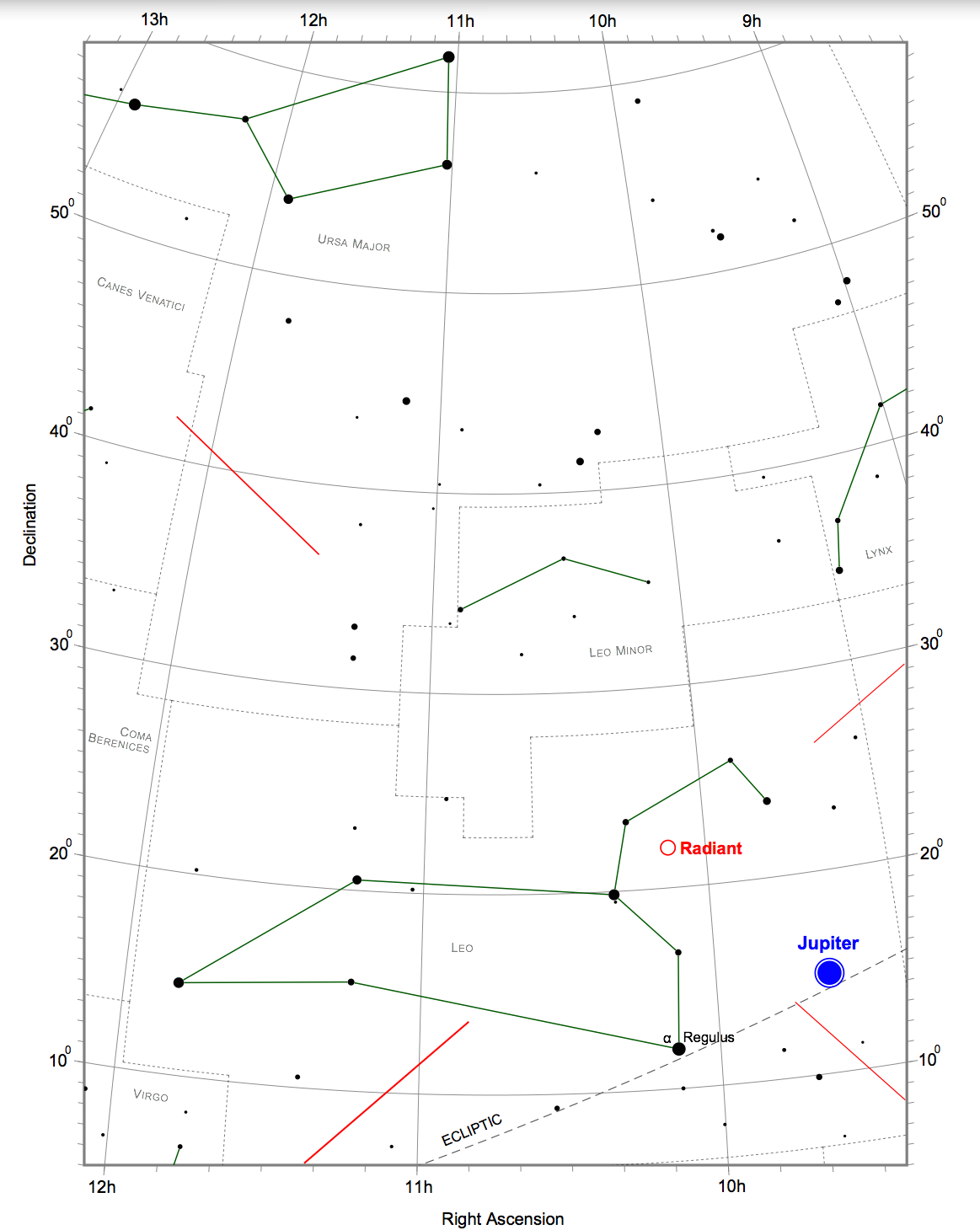
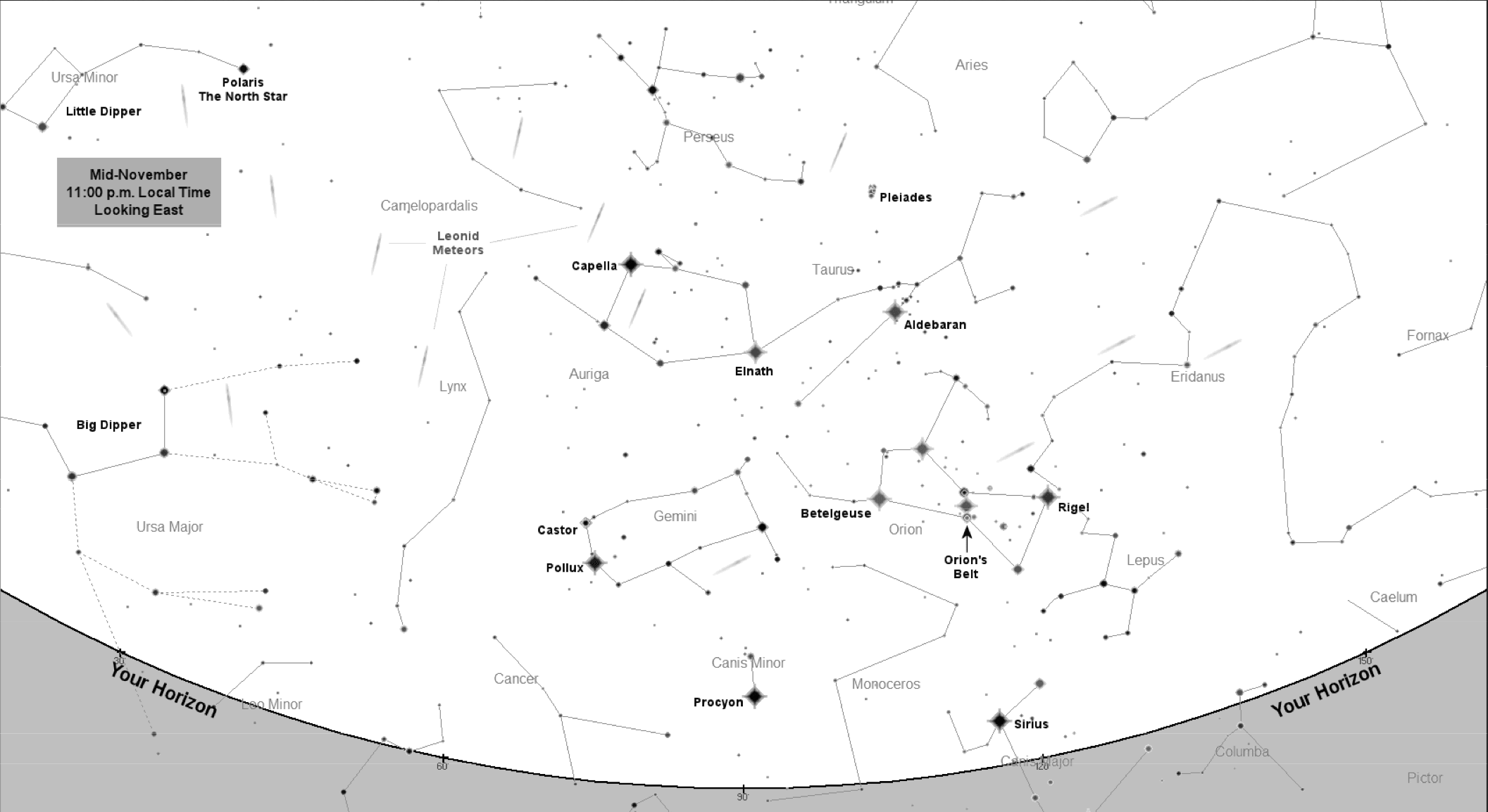
The Leonids are a prolific meteor shower associated with the comet Tempel-Tuttle. The Leonids get their name from the location of their radiant in the constellation Leo: the meteors appear to radiate from that point in the sky. (Credit: Wiki)
The November path of the radiant of the 2014 Leonids. Credit: Starry Night Education Software.
The Leonid meteor shower is forecasted to peak Monday afternoon (Nov. 17) in the U.S. eastern time zone, so stargazers in the United States are advised to look to the skies between midnight and dawn on Monday and Tuesday morning for the best view, astronomers say. This year, the Leonid meteor shower should treat skywatchers to beween 10 and 15 meteors per hour, NASA meteor expert Bill Cook, head of the Meteoroid Environment Office at the agency’s Marshall Space Flight Center in Huntsville, Alabama, told Space.com. For some meteor showers, that’s considered a decent rate.
NASA’s live stream will include a sky view from a telescope at Marshall Space Flight Center in Alabama. That stream will begin on Monday, Nov. 17 at 7:30 p.m. EST (0030 GMT Tuesday) and will continue until sunrise on Tuesday Nov. 18.
A meteor during the peak of the 2009 Leonid Meteor Shower. The photograph shows the meteor, afterglow, and wake as distinct components.(Credit: Wiki)
The Slooh live stream will begin on Monday, Nov. 17 at 8:00 p.m. EST (0100 GMT Tuesday) and will include more than just shots of the sky: Slooh will also broadcast audio of the “ionization sounds” created by the meteors. As the meteors streak through the sky, they briefly ionize the atmosphere. For a few seconds, the ionized region reflects short-wavelength radio waves, creating short blips and beeps of sound. Slooh’s broadcast will also include interviews with astronomers. (Credit: Calla Cofield and Spacce.com)
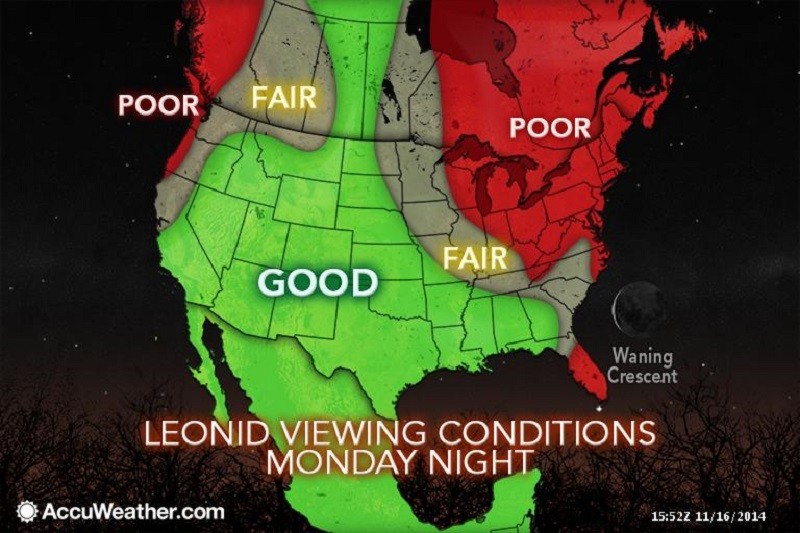
The waning-crescent moon will increase chances of a better view of the spectacle, according to NASA. This type of moon will create skies that are dark enough to view the meteors, which are characteristically bright and colorful.
“Widespread cloud cover across the eastern third of the U.S. will make it difficult to see the meteor shower Monday before dawn, except perhaps in central and south Florida. Skies should be much clearer Tuesday morning, though it may take until late at night for New England to clear out, and there will be clouds in south Florida and in the lake-effect snow belts of the Great Lakes. Clear skies will be the rule across the central and western U.S. both mornings, with only a few minor exceptions,” said Digital Meteorologist, Nick Wiltgen, from weather.com. (Credit: Carolyn Williams, weather.com)
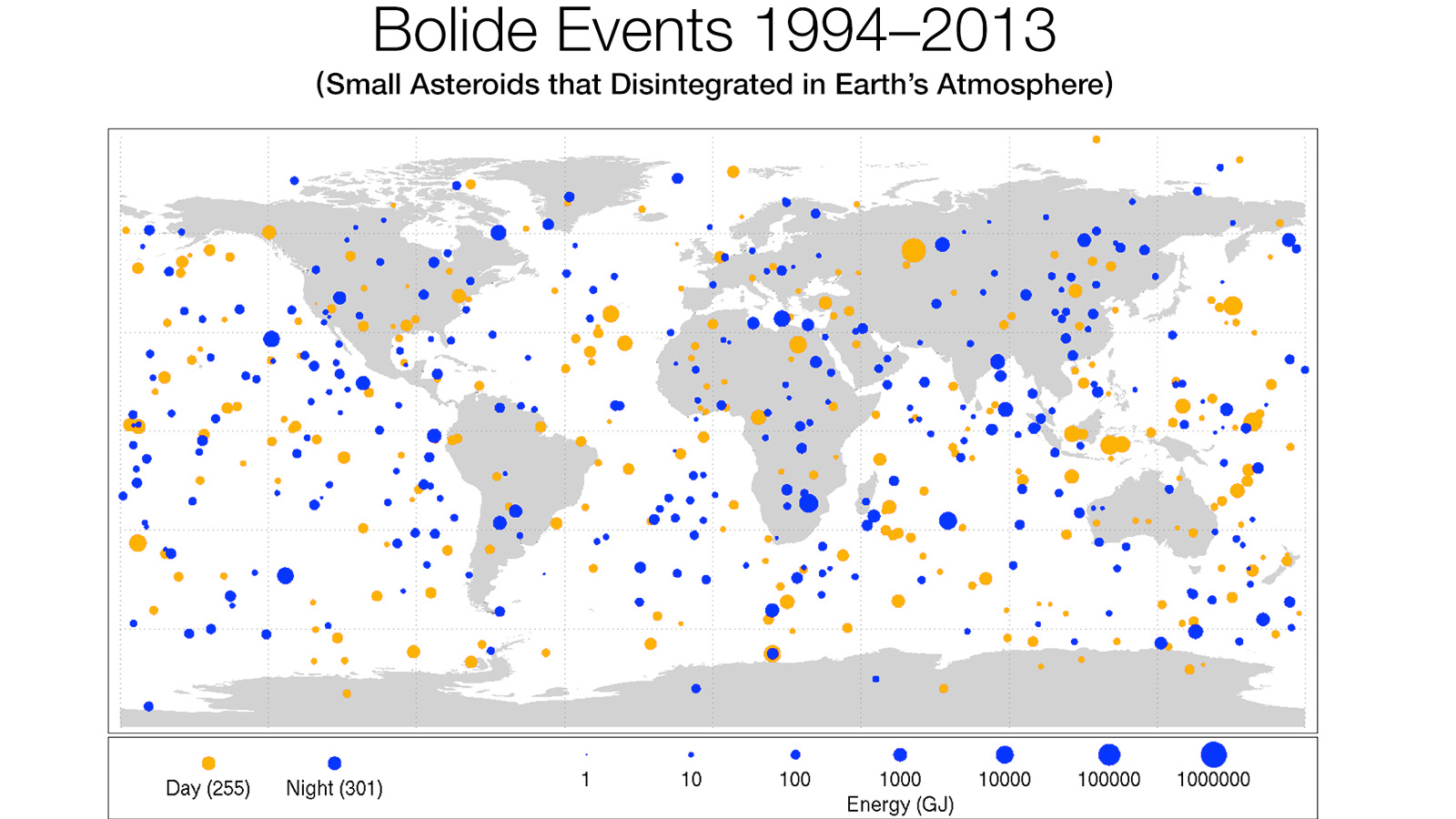
This diagram maps the data gathered from 1994-2013 on small asteroids impacting Earth’s atmosphere to create very bright meteors, technically called “bolides” and commonly referred to as “fireballs”. Sizes of red dots (daytime impacts) and blue dots (nighttime impacts) are proportional to the optical radiated energy of impacts measured in billions of Joules (GJ) of energy, and show the location of impacts from objects about 1 meter (3 feet) to almost 20 meters (60 feet) in size. Image (Credit: Planetary Science)
via scientificamerican
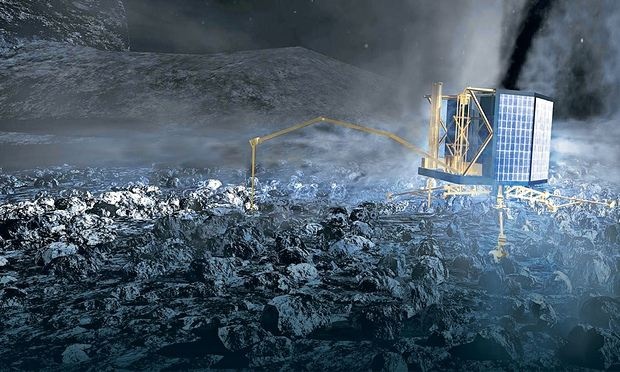
An artist’s impression of the Philae lander touching down on the comet. Photograph: Observer
“If everything had gone according to a carefully constructed plan, the European Space Agency’s Philae spacecraft would have descended from mother ship Rosetta, dropped onto its flat, wide-open landing site on Comet 67P/Churymov-Gerasimenko, relayed a rush of findings about the comet’s structure and composition, and then basked in enough sunlight to continue operating for several weeks.
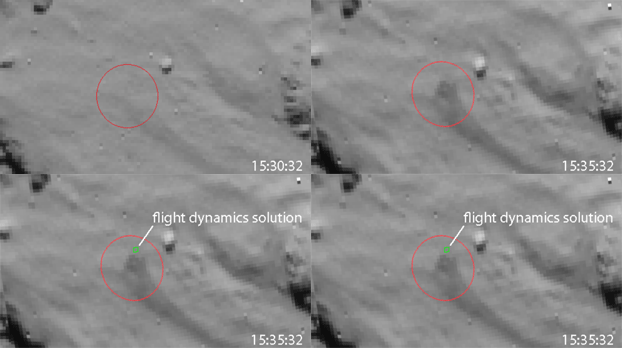
Two images, taken 5 minutes apart, zero in on the spot where Philae touched down — and then bounced away — on the surface of Comet 67P/Churyumov-Gerasimenko. The landing occurred precisely where it should have, but a pair of anchoring harpoons failed to activate. (Credit: ESA / OSIRIS team)
Troubles began when Wednesday when the lander made a pinpoint landing on Agilkia, the Sun-drenched landing site on the “head” of the twin-lobed comet. But two systems designed to anchor the craft in the ultra-low gravity — a downward-pushing thruster and two harpoons — both failed. As a result, Philae bounced not once but twice, coming to rest hundreds of meters from its intended location.
But when Rosetta returned to view, radio contact resumed at 22:19 UT. Still alive, Philae immediately started relaying findings from all 10 of its instruments. Back on Earth, engineers watched helplessly as the battery voltage plummeted. The final measurements came from Ptolemy, an instrument designed to measure ratios of atomic isotopes. After 75 minutes, the transmission ended as Philae slipped into electronic hibernation.
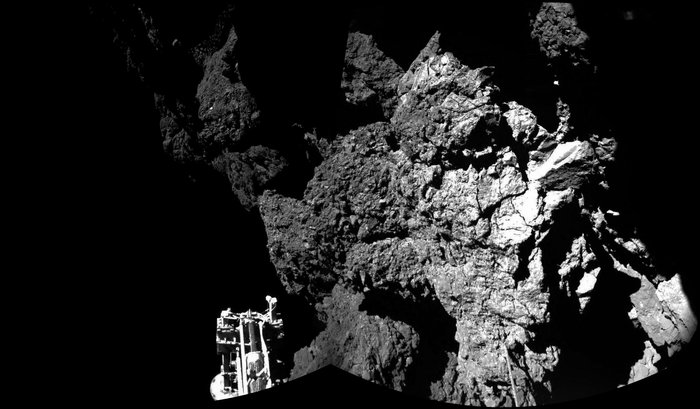
Rosetta’s lander Philae is safely on the surface of Comet 67P/Churyumov-Gerasimenko, as these first two CIVA images confirm. One of the lander’s three feet can be seen in the foreground. The image is a two-image mosaic. The full panoramic from CIVA will be delivered in this afternoon’s press briefing at 13:00 GMT/14:00 CET.(Credit: ESA/Rosetta/Philae/CIVA)
Initial images returned to Earth showed the lander wedged in rugged terrain and deep in shadow from a nearby cliff, its legs angled awkwardly and canted some 30° from horizontal. And yet, the lander was undamaged by by this roller-coaster arrival, ending up with its radio antenna pointed skyward.
Back on Earth, the mission team worked frantically to send up new commands that would salvage as many of the scientific objectives as possible. The drama intensified the morning of November 14th when a communication session with Rosetta ended at 9:58 Universal Time, just as the drill was being deployed. Some feared the battery would die before contact could be reestablished 12 hour later.
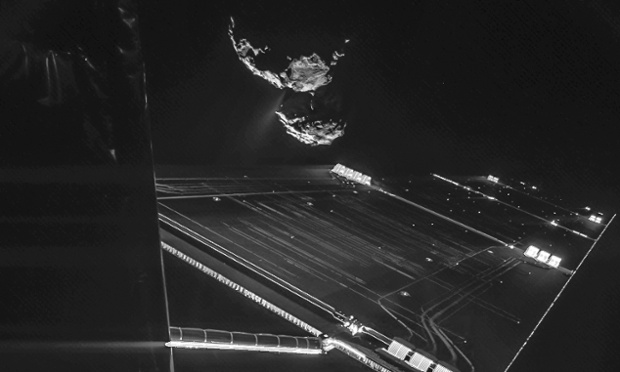
A Rosetta mission selfie with the comet Churyumov-Gerasimenko in the background. (ESA/Rosetta/Philae/Civa)
Although the lander operated for nearly 57 hours, short of the hoped-for duration, it managed to return all the results from its final sequence of measurements. There was even enough juice to rotate the lander’s body about 35°, to reposition the solar-cell panels to receive more direct sunlight.
“It has been a huge success,” exulted a weary Stephan Ulamec, lander manager for the German aerospace company DLR, which oversaw Philae’s construction. “Despite the unplanned series of three touchdowns, all of our instruments could be operated and now it’s time to see what we’ve got.” Credit: Kelly Beatty