Arrow of Time Emerges in a Gravitational System

Study of masses interacting via gravity challenges the idea that special initial conditions are needed to give time a direction (PDF)
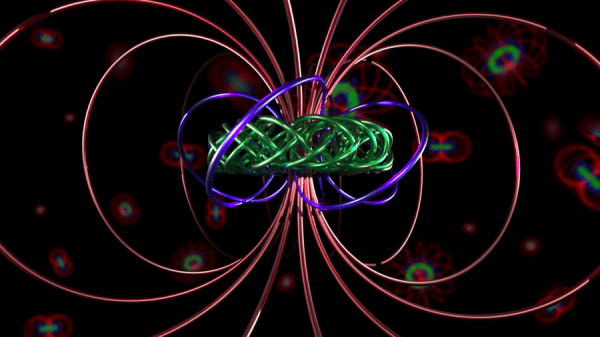
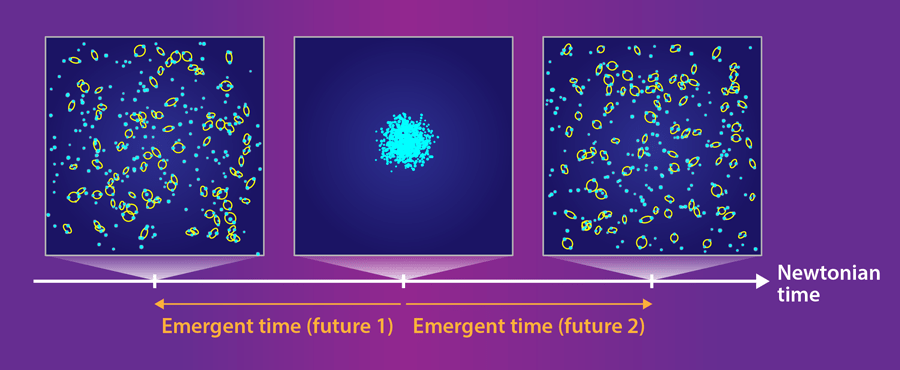
Configuration of masses evolving under Newtonian gravity. Barbour et al. show that nearly all such systems have a moment of “lowest complexity,” which they identify as a unique “past” from which two “futures” emerge. (Credit: APS/Alan Stonebraker)

The fundamental laws of physics, we believe, do not depend on the direction of time. Why, then, is the future so different from the past? The origin of this “arrow of time” has puzzled physicists and philosophers for more than a century, and it remains one of the fundamental conceptual problems of modern physics [1]. Although a preferred direction of time can occur in models of physical systems, this typically happens only if one inserts very special initial conditions. Julian Barbour at the University of Oxford and his colleagues [2] have now shown this tinkering isn’t necessary to produce an arrow of time in a system of masses interacting via Newtonian gravity. They demonstrate that the evolution of this surprisingly simple system almost always contains a unique moment of lowest “complexity,” a point they identify as a “past” from which two distinct (and more complex) “futures” emerge.

In their gravitational model, Barbour and his colleagues find a state of “low complexity” that is analogous to Boltzmann’s low-entropy fluctuation. But in their case, no rare statistical fluctuation is necessary to explain this state; instead, it arises naturally out of simple physical laws that have no explicit dependence on the direction of time. The authors study one of the simplest possible systems: a collection of N point particles interacting through Newtonian gravity. Their only assumptions are that the total energy (potential plus kinetic) and the total angular momentum of the system are zero. From earlier numerical simulations and analytic analysis, it is known that in the distant future, such a system tends to break up into weakly interacting subsystems—typically, pairs of masses in Keplerian orbits [8]. Starting with such a dispersed system and running time backwards, one might expect that it would coalesce in the past into a state of high density. Barbour and his coauthors show analytically that this expectation is right: for almost every initial configuration of masses, there is a unique moment of minimum size and maximum uniformity. From this point, the system expands outward, approximately symmetrically in both directions of time (Fig. 1). The system is therefore globally symmetric in time, as the equations dictate, and yet has a local arrow of time.

As a key step in their argument, the authors analyze the evolution of the masses in “shape space,” a space of observables that describe the shape of the system but are independent of its size and orientation. Three bodies, for instance, form a triangle, and their shape space is the space of similar triangles. Shape space contains a natural dimensionless measure of complexity, denoted 𝒞S, which is determined by the moment of inertia and the total Newtonian gravitational potential. 𝒞S describes the degree of nonuniformity and clustering; it has a minimum at the moment of minimum size and grows approximately monotonically from that minimum in both directions of time. Barbour and his colleagues provide a fairly simple and intuitive explanation for this behavior by showing that the dynamics of the N-body system in shape space has an effective friction term, which provides a sort of dissipation even though the underlying equations of motion are symmetric in time. (Credit: Steven Carlip)

via physics.aps.org

ALMA telescope spots birth of a planet in ‘milestone’ discovery

Birth of Planets Revealed in Astonishing Detail in ALMA’s ‘Best Image Ever’

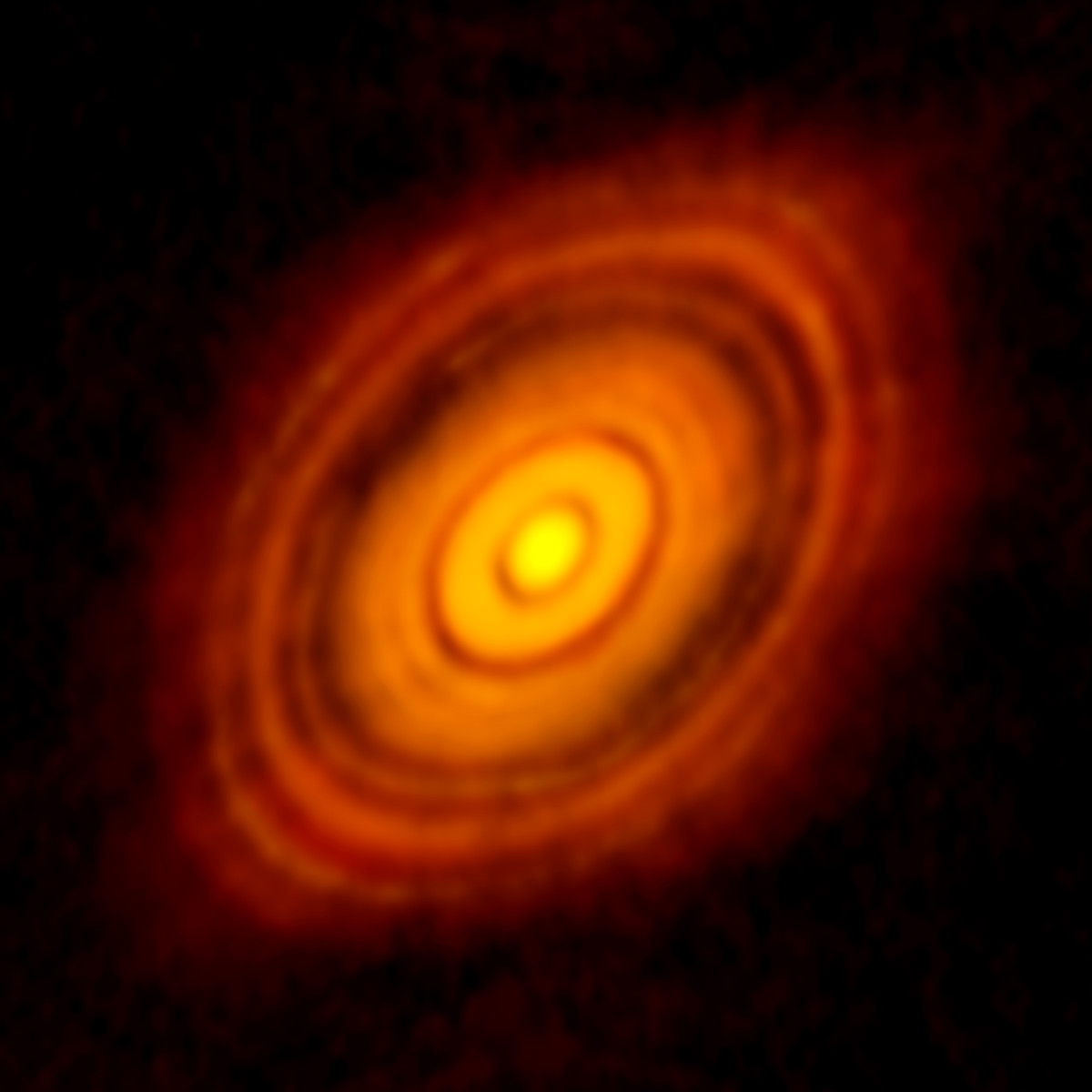
ALMA image of the young star HL Tau and its protoplanetary disk. This best image ever of planet formation reveals multiple rings and gaps that herald the presence of emerging planets as they sweep their orbits clear of dust and gas.( Credit: ALMA (NRAO/ESO/NAOJ); C. Brogan, B. Saxton (NRAO/AUI/NSF)HLTauStill)
ALMA image of the young star HL Tau and its protoplanetary disk. This best image ever of planet formation reveals multiple rings and gaps that herald the presence of emerging planets as they sweep their orbits clear of dust and gas. (Credit: ALMA (NRAO/ESO/NAOJ); C. Brogan, B. Saxton (NRAO/AUI/NSF)HLTauStill)

Astronomers have captured the best image ever of planet formation around an infant star as part of the testing and verification process for the Atacama Large Millimeter/submillimeter Array’s (ALMA) new high-resolution capabilities.

This revolutionary new image reveals in astonishing detail the planet-forming disk surrounding HL Tau, a Sun-like star located approximately 450 light-years from Earth in the constellation Taurus.

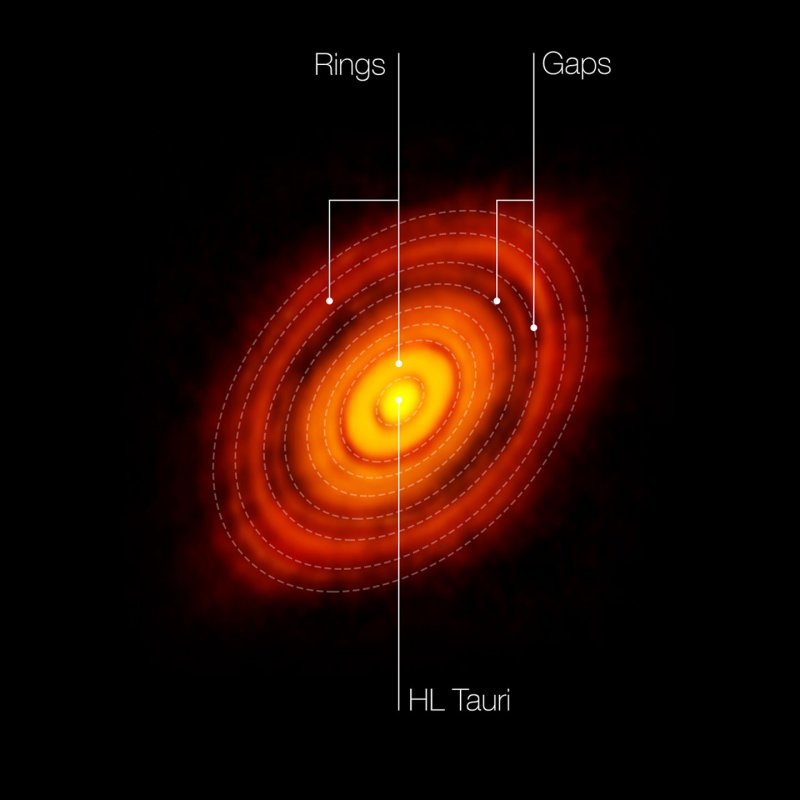
ALMA uncovered never-before-seen features in this system, including multiple concentric rings separated by clearly defined gaps. These structures suggest that planet formation is already well underway around this remarkably young star.

“These features are almost certainly the result of young planet-like bodies that are being formed in the disk. This is surprising since HL Tau is no more than a million years old and such young stars are not expected to have large planetary bodies capable of producing the structures we see in this image,” said ALMA Deputy Director Stuartt Corder.

(Credit: National Science Foundation)
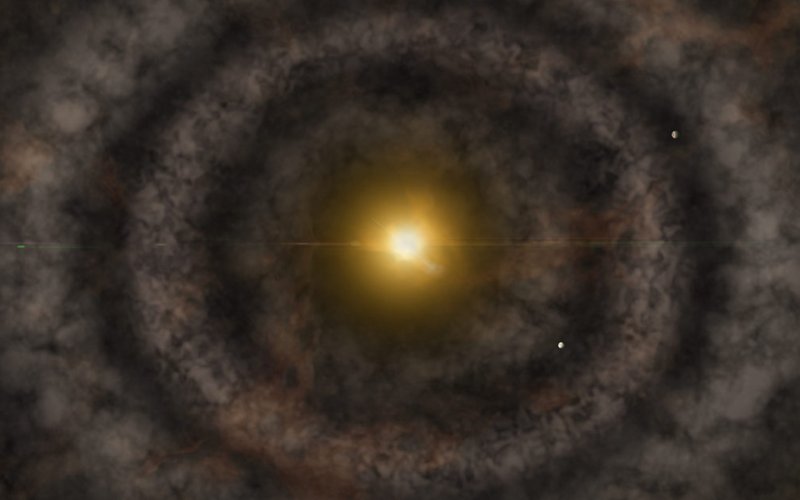
Artist’s impression of a protoplanetary disk. Newly formed planets can be seen traveling around the central host star, sweeping their orbits clear of dust and gas. These same ring-link structures were observed recently by ALMA around the young star HL Tau. (Credit: National Science Foundation, A. Khan)

The new ALMA image reveals these striking features in exquisite detail, providing the clearest picture to date of planet formation. Images with this level of detail were previously only seen in computer models and artist concepts. ALMA, living up to its promise, has now provided direct proof that nature and theory are very much in agreement.

“This new and unexpected result provides an incredible view of the process of planet formation. Such clarity is essential to understand how our own Solar System came to be and how planets form throughout the Universe,” said Tony Beasley, director of the National Radio Astronomy Observatory (NRAO) in Charlottesville, Virginia, which manages ALMA operations for astronomers in North America. (Credit: Charles E. Blue)

via public.nrao.edu

Hadron Collider ‘did NOT find Higgs Boson – but something else’

Last year CERN announced the finding of a new elementary particle, the Higgs particle. But maybe it wasn’t the Higgs particle, maybe it just looks like it. And maybe it is not alone.

Higgs Boson Particle Illustration(Credit: BIOZZ)
Higgs Boson Particle Illustration: What was found last year in CERN’s accelerator could be either the Higgs particle of the Standard Model or a light techni-higgs particle, composed of two techni-quarks. (Credit: BIOZZ)

“The current data is not precise enough to determine exactly what the particle is. It could be a number of other known particles”, says Mads Toudal Frandsen, associate professor at the Center for Cosmology and Particle Physics Phenomenology, Department of Physics, Chemistry and Pharmacy at the University of Southern Denmark.  “We believe that it may be a so-called techni-higgs particle. This particle is in some ways similar to the Higgs particle – hence half of the name”, says Mads Toudal Frandsen.

Although the techni-higgs particle and Higgs particle can easily be confused in experiments, they are two very different particles belonging to two very different theories of how the universe was created.

 "The CERN data is generally taken as evidence that the particle is the Higgs particle. It is true that the Higgs particle can explain the data but there can be other explanations, we would also get this data from other particles", Mads Toudal Frandsen. (Credit: http://sdu.dk)
“The CERN data is generally taken as evidence that the particle is the Higgs particle. It is true that the Higgs particle can explain the data but there can be other explanations, we would also get this data from other particles,” says Mads Toudal Frandsen. (Credit: http://sdu.dk)

The Higgs particle is the missing piece in the theory called the Standard Model. This theory describes three of the four forces of nature. But it does not explain what dark matter is – the substance that makes up most of the universe. A techni-higgs particle, if it exists, is a completely different thing: “A techni-higgs particle is not an elementary particle. Instead, it consists of so-called techni-quarks, which we believe are elementary. Techni-quarks may bind together in various ways to form for instance techni-higgs particles, while other combinations may form dark matter. We therefore expect to find several different particles at the LHC, all built by techni-quarks”, says Mads Toudal Frandsen.

via sdu.dk


Why Our Galaxy’s Black Hole Didn’t Eat Mystery Object

Latest research suggests enormous black hole drove two binary stars to merge into one

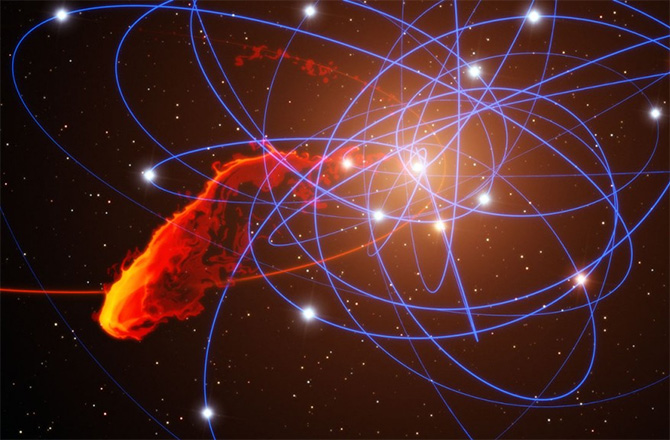
Screenshot of a simulation depicting the G2 black hole encounter... before astronomers realized G2 isn't quite what it seemed. (Credit: LECHO/MPE/M. Schartmann/L. Calçada)
Screenshot of a simulation depicting the G2 black hole encounter before astronomers realized G2 isn’t quite what it seemed. (Credit: LECHO/MPE/M. Schartmann/L. Calçada, O’Neil)

Having studied it during its closest approach to the black hole this summer, UCLA astronomers believe that they have solved the riddle of the object widely known as G2. A team led by Andrea Ghez, professor of physics and astronomy in the UCLA College, determined that G2 is most likely a pair of binary stars that had been orbiting the black hole in tandem and merged together into an extremely large star, cloaked in gas and dust — its movements choreographed by the black hole’s power.

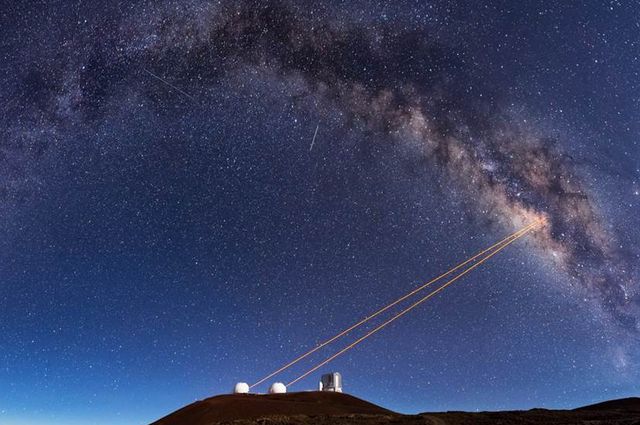
Telescopes at the Keck Observatory use adaptive optics, which enabled UCLA astronomers to discover that G2 is a pair of binary stars that merged together. (Credit:  Ethan Tweedie)
Telescopes at the Keck Observatory use adaptive optics, which enabled UCLA astronomers to discover that G2 is a pair of binary stars that merged together. (Credit: Ethan Tweedie)

Astronomers had figured that if G2 had been a hydrogen cloud, it could have been torn apart by the black hole, and that the resulting celestial fireworks would have dramatically changed the state of the black hole.

Ghez and her colleagues — who include lead author Gunther Witzel, a UCLA postdoctoral scholar, and Mark Morris and Eric Becklin, both UCLA professors of physics and astronomy — conducted the research at Hawaii’s W.M. Keck Observatory, which houses the world’s two largest optical and infrared telescopes.

Ghez said G2 now is undergoing what she calls a “spaghetti-fication” — a common phenomenon near black holes in which large objects become elongated. At the same time, the gas at G2’s surface is being heated by stars around it, creating an enormous cloud of gas and dust that has shrouded most of the massive star.

“We are seeing phenomena about black holes that you can’t watch anywhere else in the universe,” Ghez added. “We are starting to understand the physics of black holes in a way that has never been possible before.” (Credit: Stuart Wolpert)

via ucla

New Clock May End Time As We Know It

“Our aim is that we’ll have a clock that, during the entire age of the universe, would not have lost a second.”

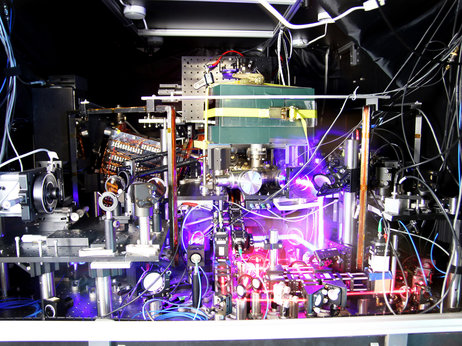
The world's most precise atomic clock is a mess to look at. But it can tick for billions of years without losing a second. (Credit: Ye group and Baxley/JILA/Flickr)
The world’s most precise atomic clock is a mess to look at. But it can tick for billions of years without losing a second. (Credit: Ye group and Baxley/JILA/Flickr)

Maybe its because we don’t understand time, that we keep trying to measure it more accurately. But that desire to pin down the elusive ticking of the clock may soon be the undoing of time as we know it: The next generation of clocks will not tell time in a way that most people understand.  The new clock will keep perfect time for 5 billion years.

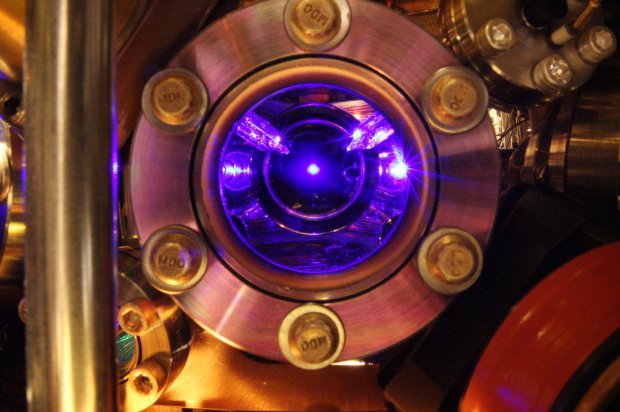
 Strontium atoms floating in the center of this photo are the heart of the world's most precise clock. The clock is so exact that it can detect tiny shifts in the flow of time itself. (Credit: Ye group, Brad Baxley/JILA)

Strontium atoms floating in the center of this photo are the heart of the world’s most precise clock. The clock is so exact that it can detect tiny shifts in the flow of time itself. (Credit: Ye group, Brad Baxley/JILA)

“My own personal opinion is that time is a human construct,” says Tom O’Brian. O’Brian has thought a lot about this over the years. He is America’s official timekeeper at the National Institute of Standards and Technology in Boulder, Colorado.

To him, days, hours, minutes and seconds are a way for humanity to “put some order in this very fascinating and complex universe around us.”

Listen to the story

via npr