First Simulated Images of Two Black Holes Colliding

The equations of general relativity are so fiendish that nobody has been able to work out what a collision between two black holes would look like, until now…  (PDF)
1*iAWwG2aymR3TmMH1fXpcfA
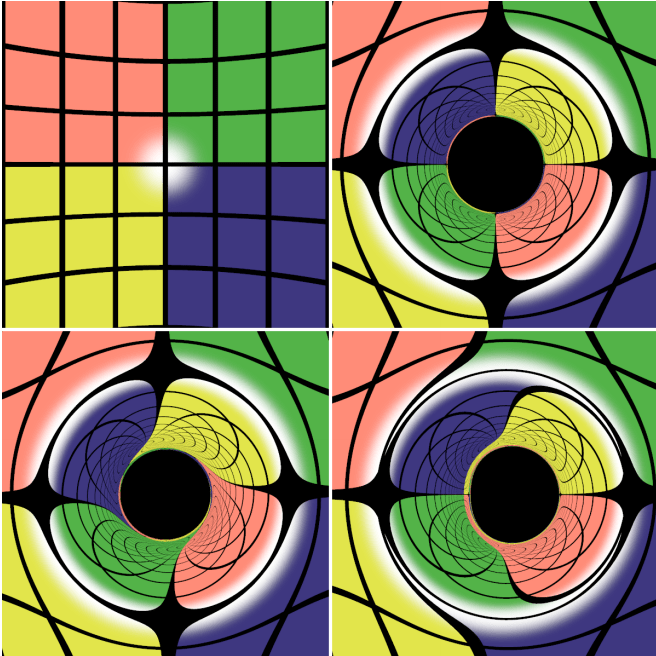
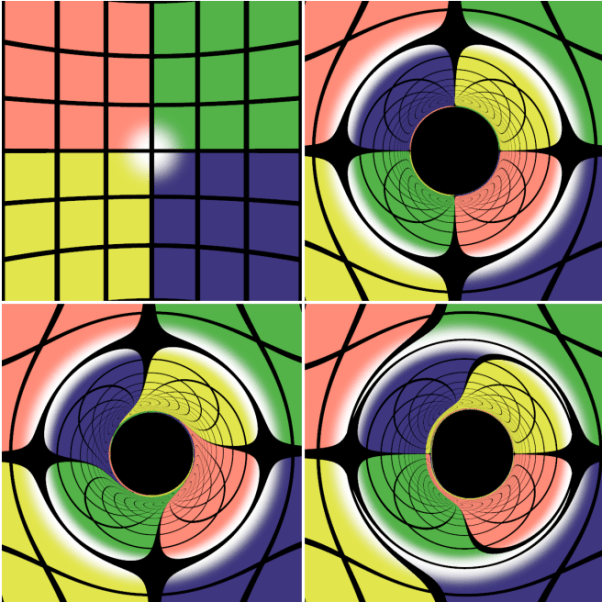
Lensing caused by various analytic spacetimes. For all panels, we use Figure 3 as a background, oriented such that the camera is pointed at the white reference dot. The camera has a 60 degree feld of view and is at a distance of 15 Schwarzschild radii from the origin measured using Kerr- Schild coordinates. The top row shows Minkowski and Schwarzschild spacetimes. The bottom row shows two views of the Kerr spacetime, with dimensionless spin x = 0.95, viewed with the camera pointing parallel to the spin axis of the black hole (bottom left) and perpendicular to the spin axis (bottom right). (Credit: A. Bohn, F. Hebert, W. Throwe, D. Bunadar, K. Henriksson, M. Scheel, N. Taylor)

The difficult part of this work is calculating the trajectory of the photons using the physics of general relativity. These equations are notoriously non-linear, so physicist sometimes simplify them by assuming that a system remains constant in the time it takes for light to pass by. The difficulty with black hole binaries is that this assumption does not hold— these objects orbit so rapidly as they approach each other that space-time warps, even during the time it takes for light to pass by.
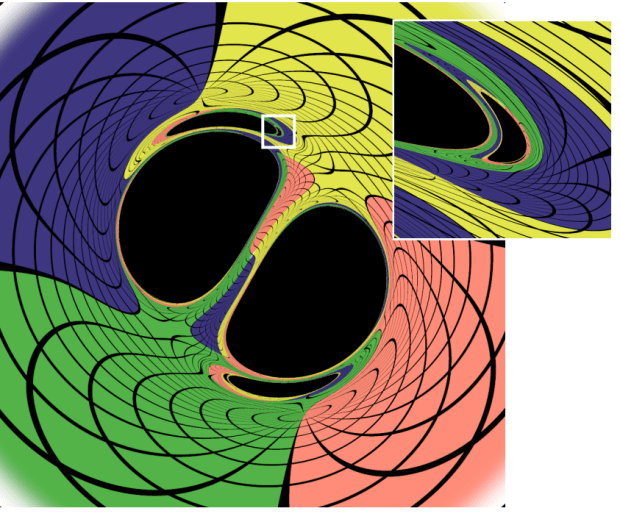
A BBH system of equal-mass black holes with no spin, viewed near merger with the orbital angular momentum out of the page.
A BBH system of equal-mass black holes with no spin, viewed near merger with the orbital angular momentum out of the page. (Credit: A. Bohn, F. Hebert, W. Throwe, D. Bunadar, K. Henriksson, M. Scheel, N. Taylor)

Andy Bohn(et al.) at Cornell University in Ithaca, New York, reveals how in-spiraling black hole pairs should distort the light field around them. The team has concluded that from large distances, binaries are more or less indistinguishable from single black holes. Only a relatively close observer would be able to see the fascinating detail that they have simulating or one with very high resolving power.

The first observation of much bigger deflections, such as those produced by black holes or black hole pairs, will be something of a triumph for whoever spots them first.

via physics arxiv
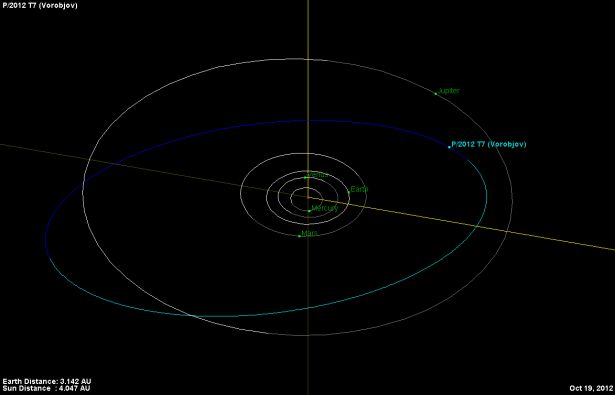
Comet Discovered at SkyCenter!

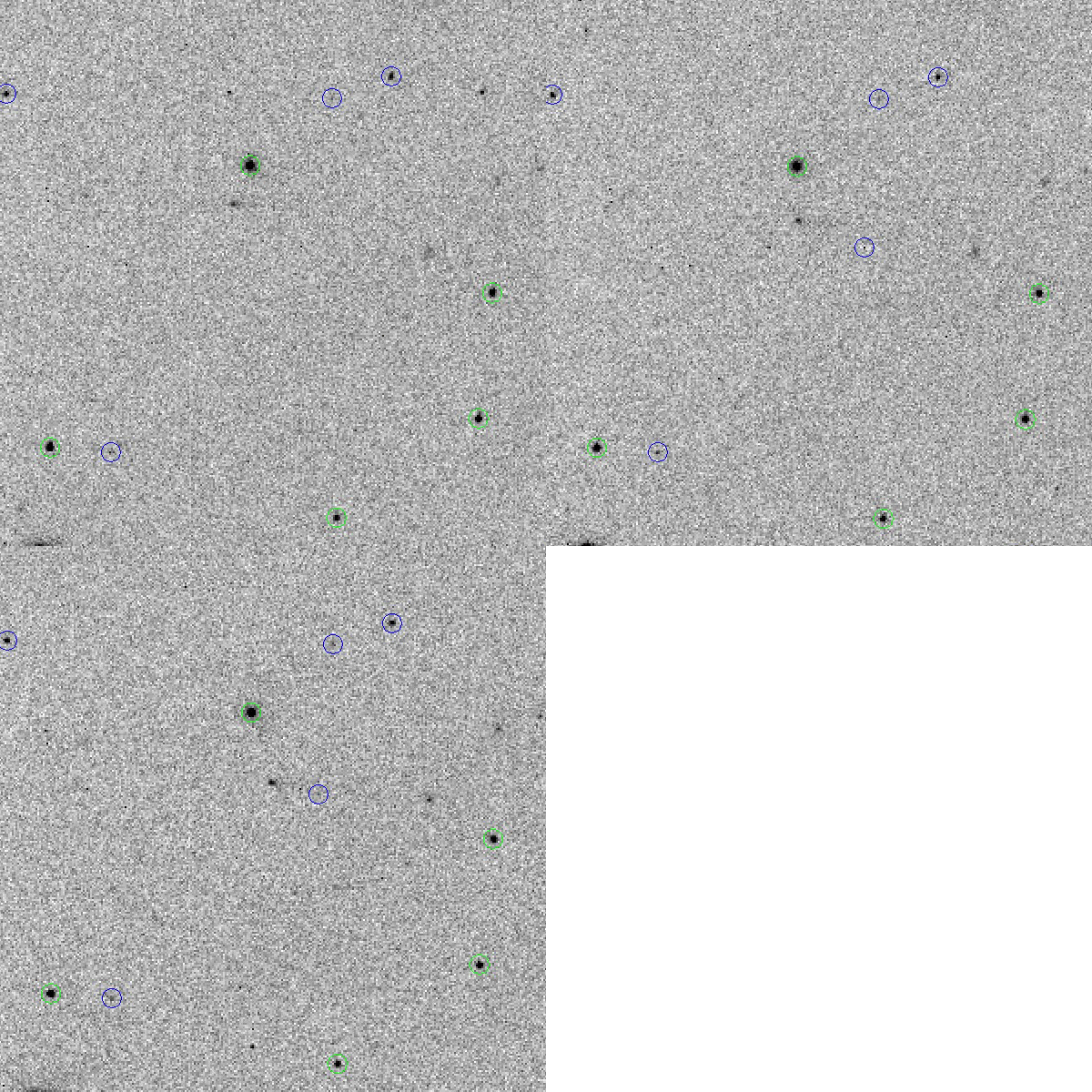
The first comet discovered by observers using the Schulman Telescope.

Dedicated only six months ago as the nation’s largest instrument of its kind devoted to public outreach and citizen science, the 32-inch Schulman Telescope at the Mt. Lemmon SkyCenter has shown that it can do more than offer awe-inspiring glimpses into the universe.

“We originally scheduled our observations for Saturday (Oct. 14), but the SkyCenter telescope was used for local operations by visiting astronomers. Therefore, I had to move the jobs to Sunday. If the Schulman Telescope had been running for SSON on Saturday, the comet most likely would have been outside the field of view and I wouldn’t have found it.” (Credit: Daniel Stolte, University Communications)

In this sequence assembled from three discovery images taken about 30 minutes apart, the comet can be seen as a black speck moving toward the lower right near the center of the image and a faint tail can be seen moving along with the comet on its right side. Similar to a photo negative, black and white have been inverted in the image to make objects easier to spot. (Credit: Tomas Vorobjov)
via uanews

How Could Quantum Physics Get Stranger?

Shattered Wave Functions

“A team of physicists based at Brown University has succeeded in shattering a quantum wave function. That near-mythical representation of indeterminate reality, in which an unmeasured particle is able to occupy many states simultaneously, can be dissected into many parts. This dissection, which is described this week in the Journal of Low Temperature Physics, has the potential to turn how we view the quantum world on its head.”

via vice

Russian rocket manufacturer insists it is not to blame for Antares crash

Kuznetsov company says engines used in Antares rocket were ‘functioning normally’ and suggests problem may lie with US modification of them

The launch phase of the Orbital Sciences Corporation’s Antares rocket relied on two AJ-26 engines that were originally produced in the 1970s for a failed Soviet moon program and later modernised for US space flights. Speculation quickly centered on the Soviet-based engines, which have failed in tests, when the rocket exploded in a giant fireball after takeoff on Tuesday night.

via theguardian

Watch an Amazing Solar Flare

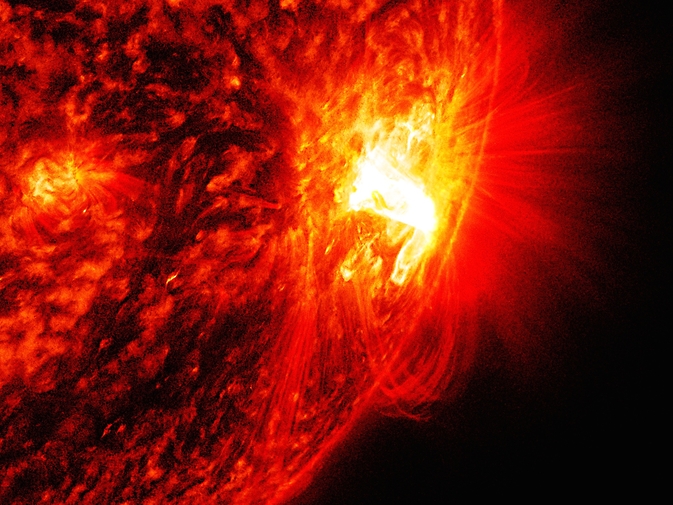
SDO captured a splendid example of expanding coronal loops seen in profile at the edge of the Sun (Oct. 14-15, 2014). The bright loops began to form and grow after a long-lasting M-class flare erupted. The arcs of the loops we see in extreme ultraviolet light are actually particles spiraling along magnetic field lines arcing above the active region that was the source of the flare. They are reorganizing the magnetic field after its disruption. To give a sense of scale, these huge loops are reaching out more than 15 times the size of Earth.

(Credit: Solar Dynamics Observatory/NASA)