Einstein’s greatest legacy – How demons and angels advanced science

Einstein’s greatest legacy is not General Relativity, it’s not quantum entanglement, and it’s not slices of his brain either.
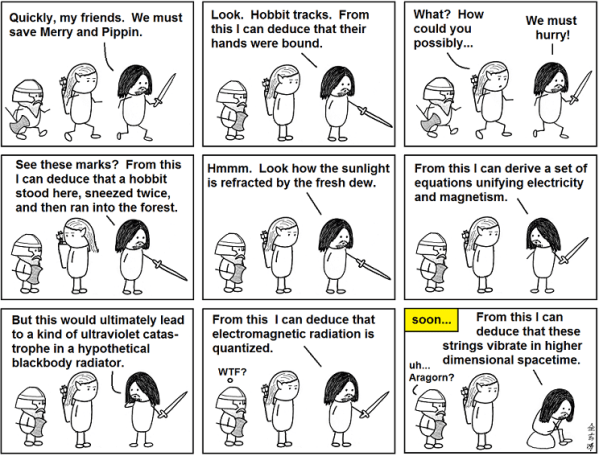
(Credit: Abstruse Goose, Missed Calling, S. Hossenfelder)

“Einstein, like no other physicist before or after him, demonstrated how the power of human thought alone, used skillfully, can make up for the lack of real experiments. He showed we little humans have the power to deduce equations that govern the natural world by logical conclusion. Thought experiments are common in theoretical physics today. Physicists use them to examine the consequences of a theory beyond that what is measurable with existing technology, but still within the realm of that what is in principle measurable. A thought experiments pushes a theory to its limit and thereby can reveal inconsistencies or novel effects. The rules of the game are that a) relevant is only that what is measurable and b) do not fool yourself. This isn’t as easy as it sounds.” (Credit: Hossenfelder)

via backreaction
Sun’s stroke keeps Kepler online

Space telescope beats mechanical failures to begin a second mission that will trace new celestial targets.

214251main_ssc2008-03a1_full for WEB
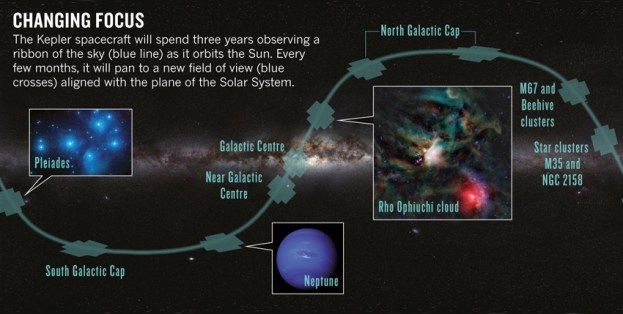
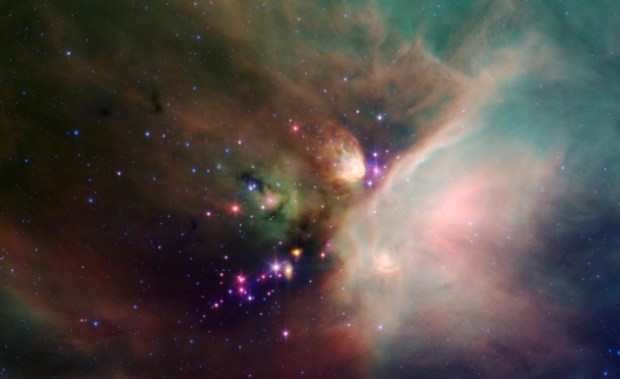
The Rho Ophiuchi cloud, a star-forming nebula, is being observed by the Kepler space telescope. ( Credit: NASA/JPL-Caltech/Harvard-Smithsonian CfA)

The crippled Kepler space telescope is unexpectedly enjoying a second lease of life. The exoplanet-hunting probe will now cast its gaze on star clusters, the centre of the Milky Way and the Solar System’s outer planets as it scans a ribbon of the cosmos for the next three years. This month it has been gazing at gas clouds shrouding infant stars in the constellations Scorpius and Ophiuchus. (Credit: Mark Zastrow)

via Nature

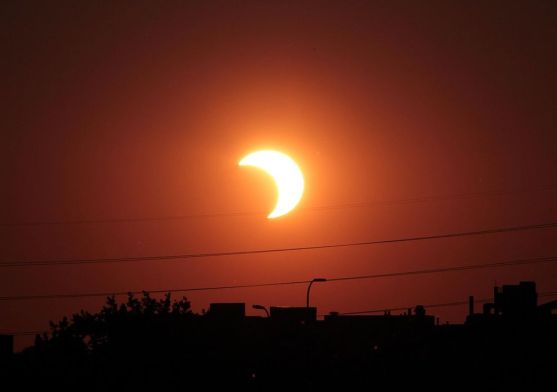
Partial Solar Eclipse Graces Skies on Thursday

North Americans will watch the moon take a bite out of the sun.

partial-solar-eclipse_84918_990x742
The next total solar eclipse occurs over the remote northern Atlantic on March 20, 2015. But this week’s partial event in North America will be a great warmup for the much anticipated total solar eclipse on August 21, 2017, when a 37-mile-wide (60 kilometers) total eclipse, a “zone of totality,” will run from North Carolina through Oregon. (Credit: T. Ruen, NASA, Andrew Fazekas)
via National Geographic

NASA’s Fermi Satellite Finds Hints of Starquakes in Magnetar ‘Storm’

NASA’s Fermi Gamma-ray Space Telescope detected a rapid-fire “storm” of high-energy blasts from a highly magnetized neutron star, also called a magnetar, on Jan. 22, 2009. Now astronomers analyzing this data have discovered underlying signals related to seismic waves rippling throughout the magnetar.

NASA's Fermi Gamma-ray Space Telescope detected a rapid-fire "storm" of high-energy blasts from a highly magnetized neutron star, also called a magnetar, on Jan. 22, 2009. Now astronomers analyzing this data have discovered underlying signals related to seismic waves rippling throughout the magnetar.
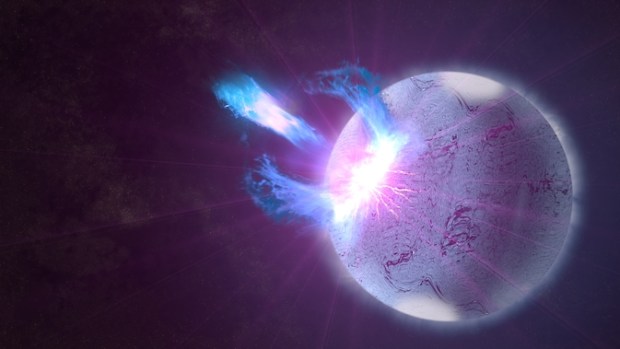
A rupture in the crust of a highly magnetized neutron star, shown here in an artist’s rendering, can trigger high-energy eruptions. Fermi observations of these blasts include information on how the star’s surface twists and vibrates, providing new insights into what lies beneath.
via Francis Reddy: NASA’s Goddard Space Flight Center

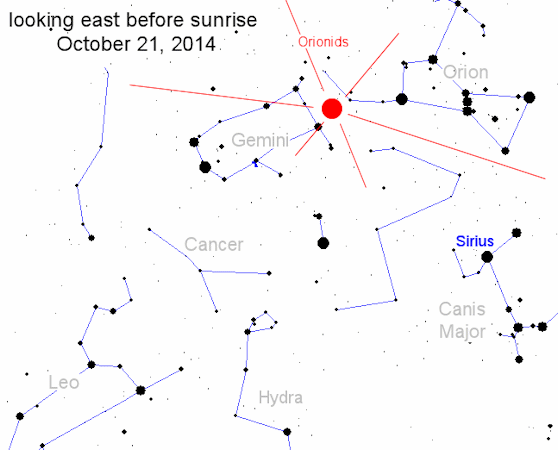
Watch live! NASA streams Orionid meteor shower


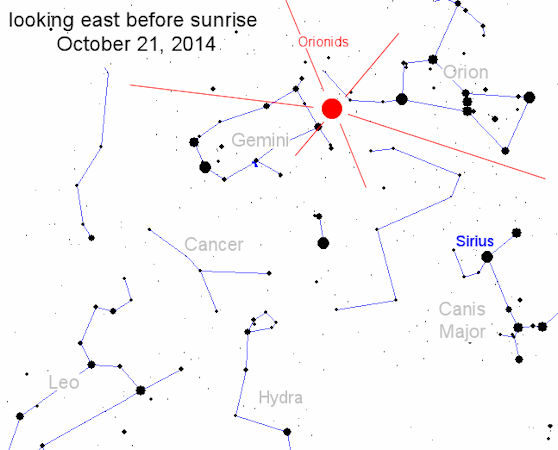
“The Orionid meteor shower is not the strongest, but it is one of the most beautiful showers of the year,” said Bill Cooke, the head of NASA’s Meteoroid Environment Office. “We expect to see about 20 meteors per hour when the shower peaks on Tuesday morning, October 21. With no Moon to spoil the show, observing conditions should be ideal.”

via nasa